Archive for the ‘Uncategorized’ Category
My 2015 Iowa travel planner
 Comments (2)
2015, so far, has been cold, snowy, and encouraging me to do nothing but sit in my living room and read. (And make pots of soup and drink what’s left of the good Christmas booze and occasionally venture out to the cineplex to see last year’s Oscar-worthy movies that are slowly making their way to Iowa.)
January may be the worst month to actually do anything exciting, but it’s the best month to plan fun stuff to do for the rest of the year.
A few months ago, when I was thinking about places to visit for the blog this year, I ran out a map of Iowa and put dots everywhere I’ve written about. No surprise to me that more of the dots were in central Iowa than anywhere else, because that’s where I live. I also have lots of dots in northeast Iowa, dots along the western border, dots all along the Hwy. 30/I-80 corridor, and dots in southeast Iowa. I have a few others here and there, but with this stark black-and-white map and these bright red dots, it’s easy to see where I HAVEN’T been, so that gives me a start on my planning. Plus, there are several really obvious Iowa places and events that I still haven’t checked off my list.
Here are my thoughts for 2015:
- Spend some time in the Quad Cities, and all along Iowa’s far eastern corridor, in places like Muscatine, Clinton, and Maquoketa. This area is totally devoid of red map-dots. I’m especially looking forward to visiting the Figge Art Museum in Davenport.
- Stay overnight at Honey Creek Resort and explore the area around Lake Rathbun. This should be fun in any season.
- Drive another Iowa scenic byway. Last year I did the Loess Hills in western Iowa and Historic Hills in southeastern Iowa. I’ve driven much of the Grant Wood and Western Skies byways, the northern section of the Great River Road, and parts of several other scenic drives. Which one should I do next? I’m leaning toward the Glacial Trail in northwest Iowa because the route seems so unfamiliar to me.
- Speaking of routes, I still want to drive the entire RAGBRAI route this summer, just before RAGBRAI actually begins. I’ve wanted to do this for several years, and for one reason or another there just never seems to be enough time. A couple of years ago I drove the first couple of “days” in just a few hours – car days are a lot faster than bike days – and it was so much fun. As soon as the Register announces the exact route, I’m going to start planning.
- Another trail I’d like to do (these are so much fun for me!) is the historic Dragoon Trail, a 200-mile corridor along the Des Moines, Boone, and Raccoon Rivers. I’ve seen the signs for years but never bothered to follow them or learn more about the Dragoons, a mounted infantry unit.
- I’m still trying to wrap my brain around the Silos and Smokestacks National Heritage area. This National Park Service National Heritage Area seems to encompass pretty much everything from Des Moines to Clear Lake, Decorah to Davenport, and everything within those boundaries. A brochure describes the area as “where the story of American agriculture comes to life,” but many of the sites and attractions are anything but agricultural. Maybe I’ll use the planning guide to locate interesting places to stop when I head over to Davenport.
- I’ve been to Fairfield a number of times, but I’d like to really explore the town and nearby Maharishi Vedic City. Fairfield also has what sounds like a terrific first-Friday art walk, with lots of art galleries, plus great restaurants.
- How many years have I had “Orange City Tulip Time” on my list of things to do? Um, at least six years, maybe longer. Will this be the year? I really hope so, but it’s going to be a busy spring, so who knows?
I have lots more on my list, but I’d love to hear what readers think I should do this year. Give me your suggestions!
2014 year in review
In keeping with all the Top 10 lists that choke the airwaves and Internet at this time of year, here is my very simple list of top Iowa travel experiences of 2014:

Number 3: OKTOBERFEST IN THE AMANA COLONIES
https://iowagirlonthego.com/2014/10/05/oktoberfest-in-amana/
Polka music! Beer! German food! More beer! Oktoberfest in the Amana Colonies has it all, plus a pretty decent parade.

Number 2: VILLAGES OF VAN BUREN COUNTY / HISTORIC HILLS SCENIC BYWAY
https://iowagirlonthego.com/2014/10/17/villages-of-van-buren/
I really loved the two days I spent in this way-off-the-beaten-path county in southeast Iowa. There’s some very old architecture in these quaint, blink-or-you’ll-miss-them villages, with Amish farmsteads and shops, tiny museums, and scenic drives. Lacey-Keosauqua State Park and Shimek State Forest provided lovely fall color, and you can’t beat a stay at the Hotel Manning in Keosauqua, where you can get a shared-bath room for $50, a hot breakfast included.
Number 1: LOESS HILLS SCENIC BYWAY
https://iowagirlonthego.com/2014/08/09/loess-hills-scenic-byway/
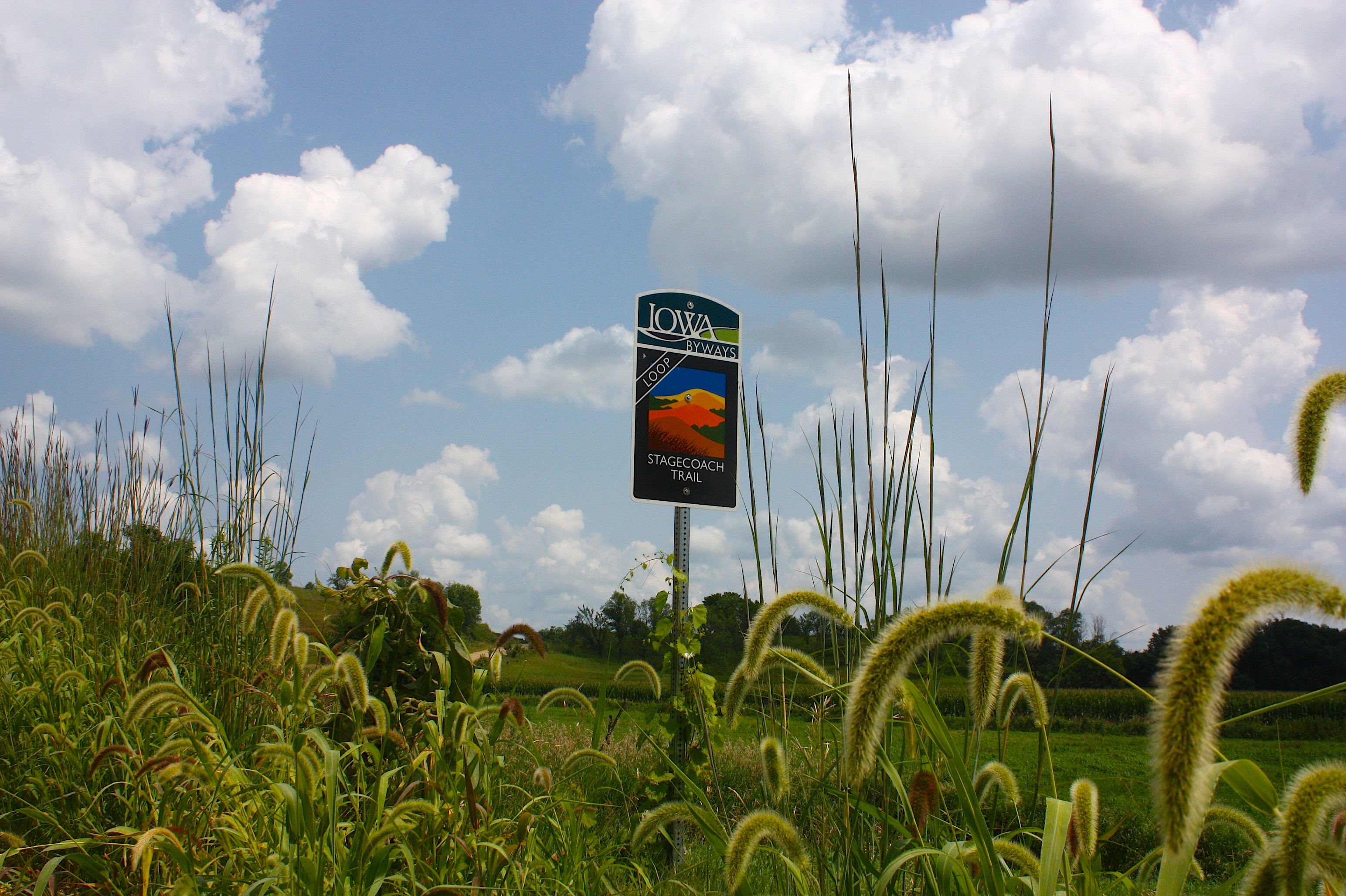
This north/south byway in western Iowa is very pretty, it’s mostly rural, and it’s completely unique. I went in August and had many of the loop roads all to myself. Several times I literally left my car in the middle of the gravel road – running, doors open – while I walked around and took pictures of the scenery. Highlights included the Hitchcock Nature Center, Broken Kettle Grasslands, Waubonsie State Park, Preparation Canyon State Park…and those crazy loop roads. If you go, give yourself at least two days. Three would be better. Bring a good map of the area.
And the rest
Several of my 2014 outings were repeats from previous years (the Des Moines Art Center, Ledges State Park, High Trestle Trail, and Picket Fence Creamery) and annual events (Ames’ Octagon Arts Festival, Des Moines’ Arts Festival, the Iowa State Fair, and the Historic East Village Holiday Promenade). But I also had a fine time shopping for antiques in Walnut, visiting the Danish-American Museum in Elk Horn, and discovering new attractions in Cedar Rapids.
Outside Iowa
I spent a fair amount of 2014 exploring destinations outside the state. In March I went to one of my all-time favorite places: New York City. My husband, Dave, and I spent a few days driving the Natchez Trace Parkway (Nashville, Tenn., to Natchez, Miss.) in May, and later that same month I took a weeklong Greek Isles cruise that also included a stop in Istanbul, Turkey. We took a quick family vacation in June to Innsbrook, Mo., a resort community just west of St. Louis, where we rented a lake house and just kicked back. Dave and I spent a red-white-and-blue Fourth of July in Boston, perhaps the most patriotic place in America. And in September we did a driving tour of Michigan’s Upper Peninsula.
Happy New Year!
Holiday Promenade
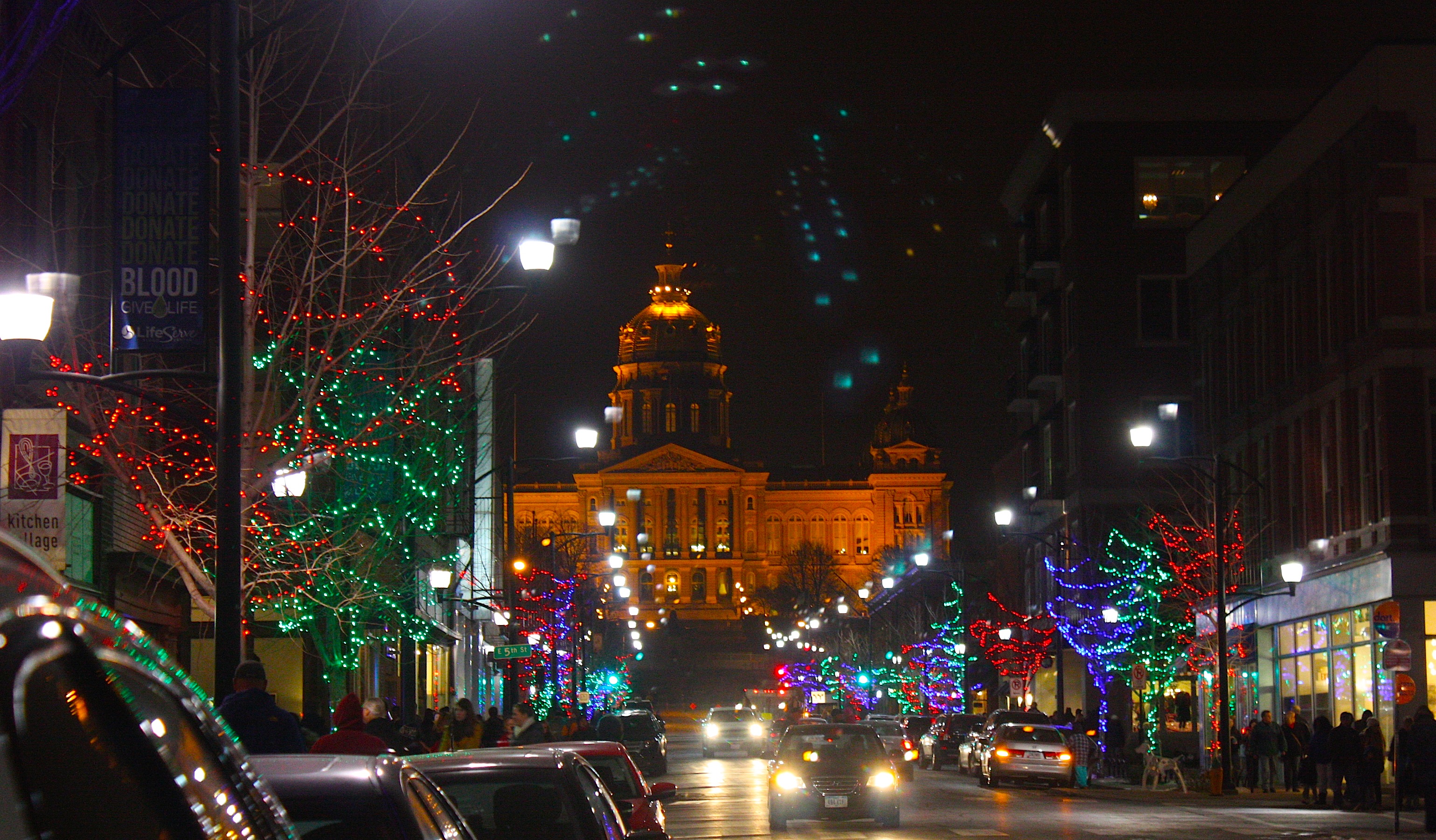
The holidays just got a little brighter in Des Moines! Last night’s Historic East Village Holiday Promenade was a sparkly, twinkly way to kick off the holiday shopping season. Even the weather cooperated — mostly. It was much warmer than it’s been here all week, and a few sprinkles didn’t seem to dampen spirits.
I hate to admit that hadn’t made it to this event before this year, even though this is the 13th annual Promenade. I always seem to have an excuse! But I’m so glad I went. Not only were the shops decorated for the holidays — and equally packed with merchandise and shoppers — but the entire Historic East Village was decked out in colored lights.
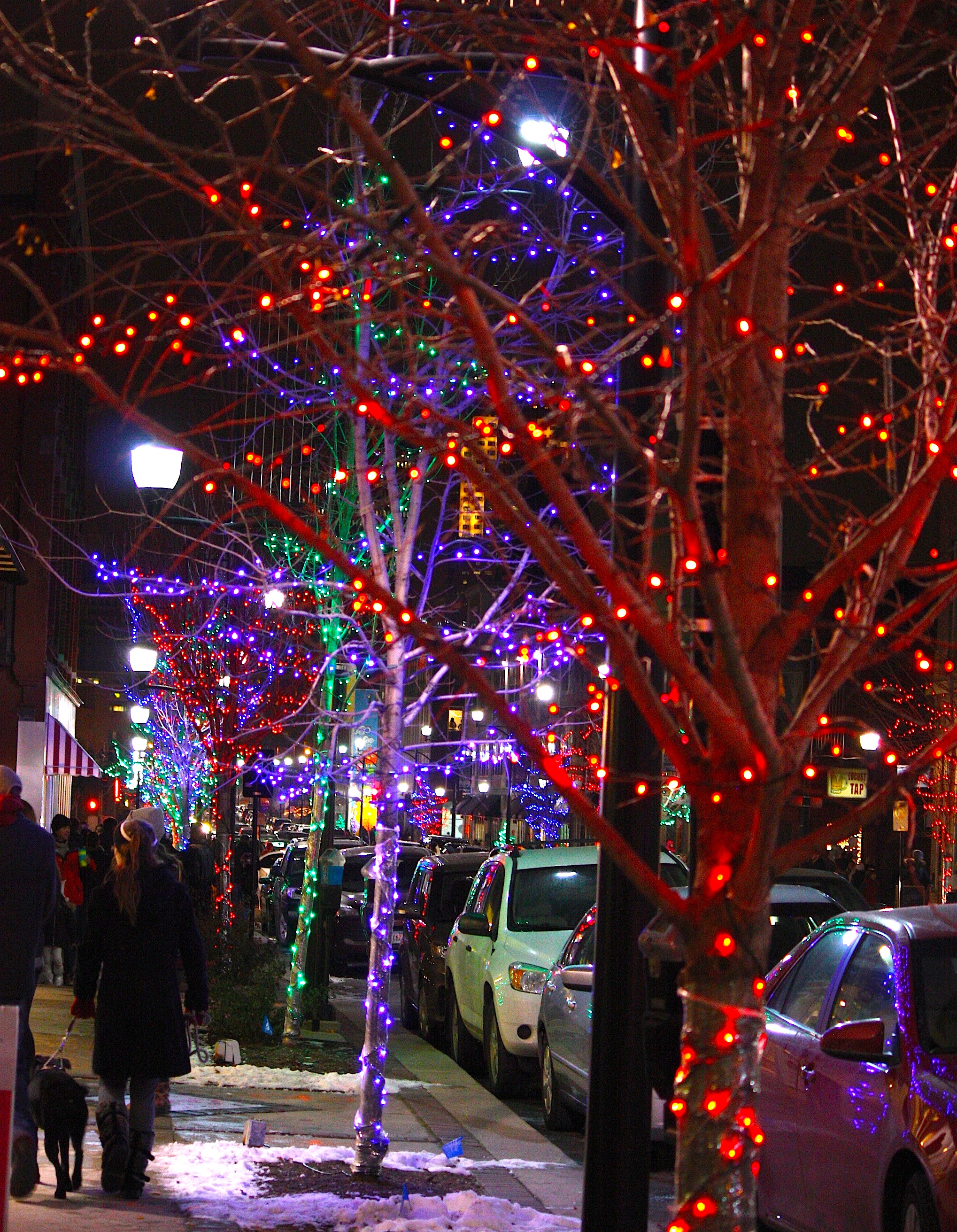
The good news, if you missed this event, is that visitors can continue to enjoy the lights and decorated shops throughout the holiday season.
Last night’s event, though mostly focused on shopping, also included horse-drawn trolley rides, dancers, carolers, and Nutcracker performances by Ballet Des Moines. Santa was nearby, too, at Brenton skating plaza.
I did not expect to find a table at any of the many East Village eateries, so I was surprised when I walked by Lucca and saw that it was not packed with people. Yes, please! And although the menu was a three-course prix fixe for $40 per person, the server kindly let me order just a first (salad) and second (pasta) course for a reduced price.
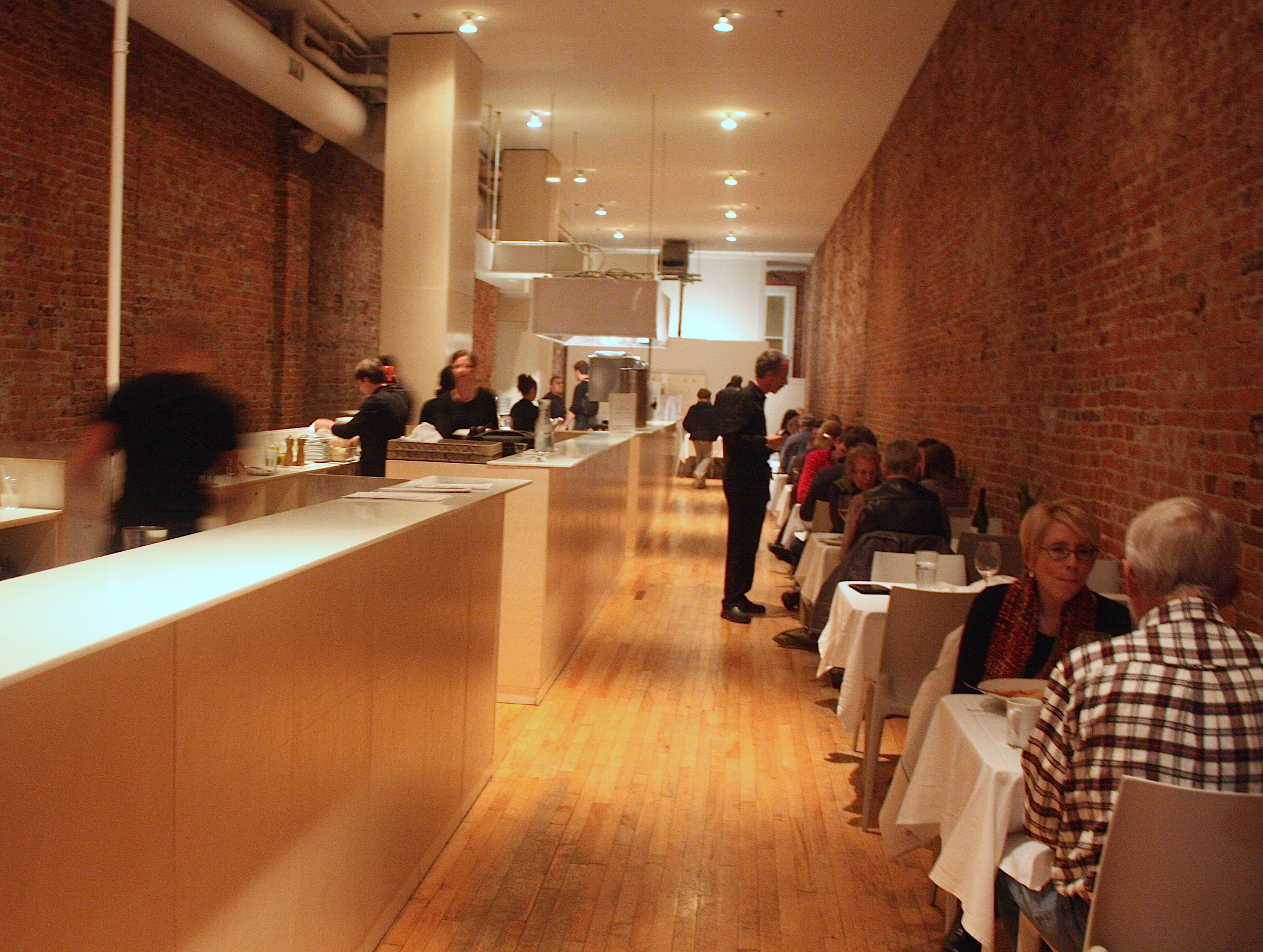

I had a wonderful, citrusy spring mix salad followed by to-die-for cheesy, oniony risotto…and a glass of pinot noir. Dave had spinach salad and some kind of beef. Even with the two courses, we were too full for dessert and ready to go back into the cool night air for some window shopping.
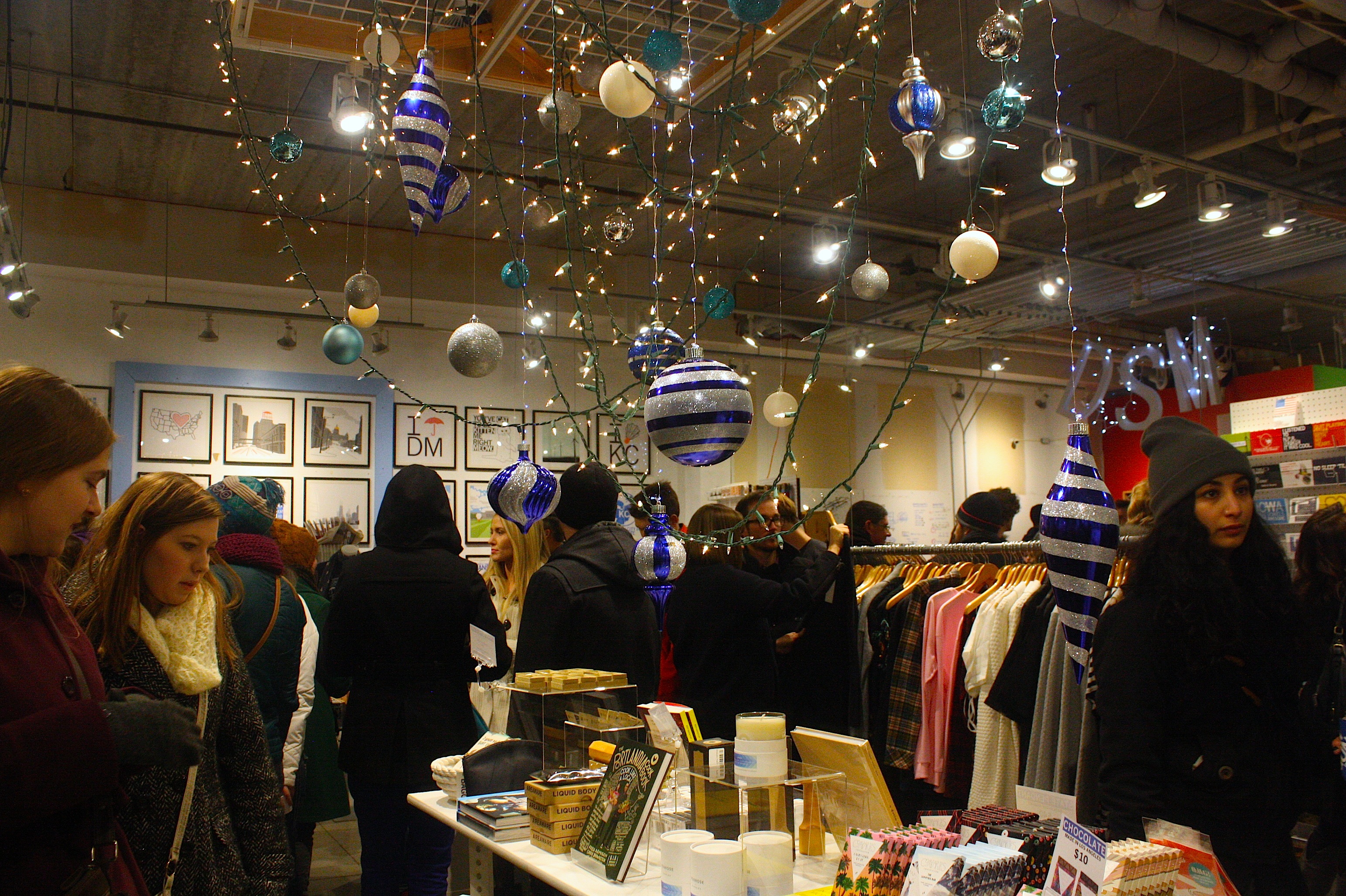
I haven’t been to East Village for a few months and it just seems like there are more shops than there used to be — plus some new services like a blow dry bar and a spa (although maybe they’ve been there for awhile and I just didn’t notice). We walked through Sticks and Raygun (above) — both were so crowded you could barely move. Mostly we just peeked into windows.


It’s definitely looking (and feeling) a lot more like Christmas! Happy Thanksgiving!
Villages of Van Buren

My weekend in southeast Iowa was filled with fascinating history, winding two-lane highways, fall leaves, a 115-year-old hotel, and some really tiny towns.
This was a weekend I’d been looking forward to for a long time: The Scenic Drive Festival in the Villages of Van Buren County. Basically, I wanted to visit this area and figured that A) the leaves would be pretty this time of year and B) shops would be open if there was some kind of festival. I really didn’t much care about the festival itself, which involved a lot of soup suppers and flea markets.
Like most of my weekend explorations, this one started with some basic research. I downloaded a copy of the Scenic Drive Festival brochure and added that to the Villages of Van Buren 2014 visitors guide and Iowa Byways brochure I’d picked up on some other trip. And I pulled out the Sept. 25, 2011 Des Moines Register feature by Mike Kilen about driving the 110-mile Historic Hills Scenic Byway.
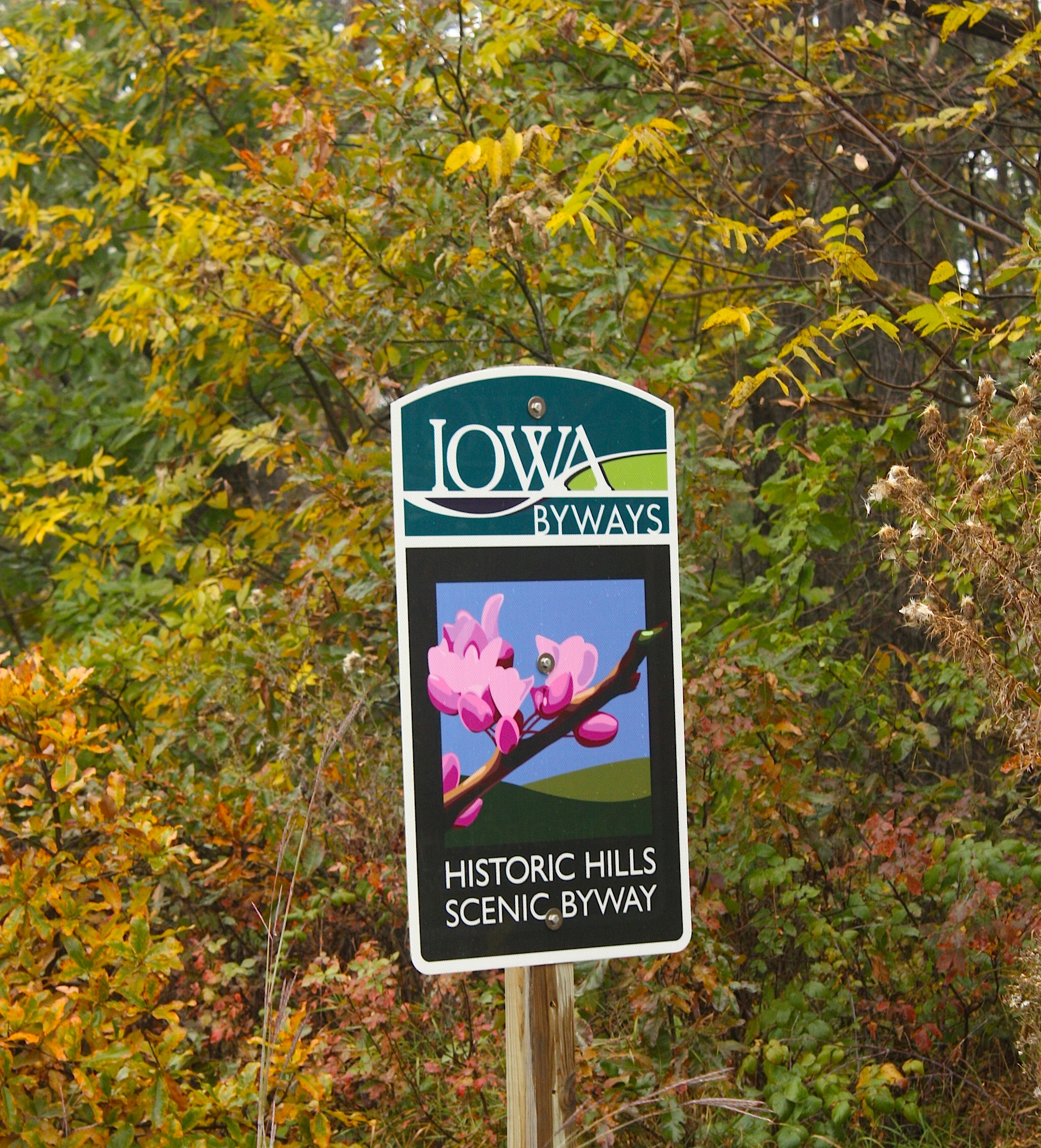
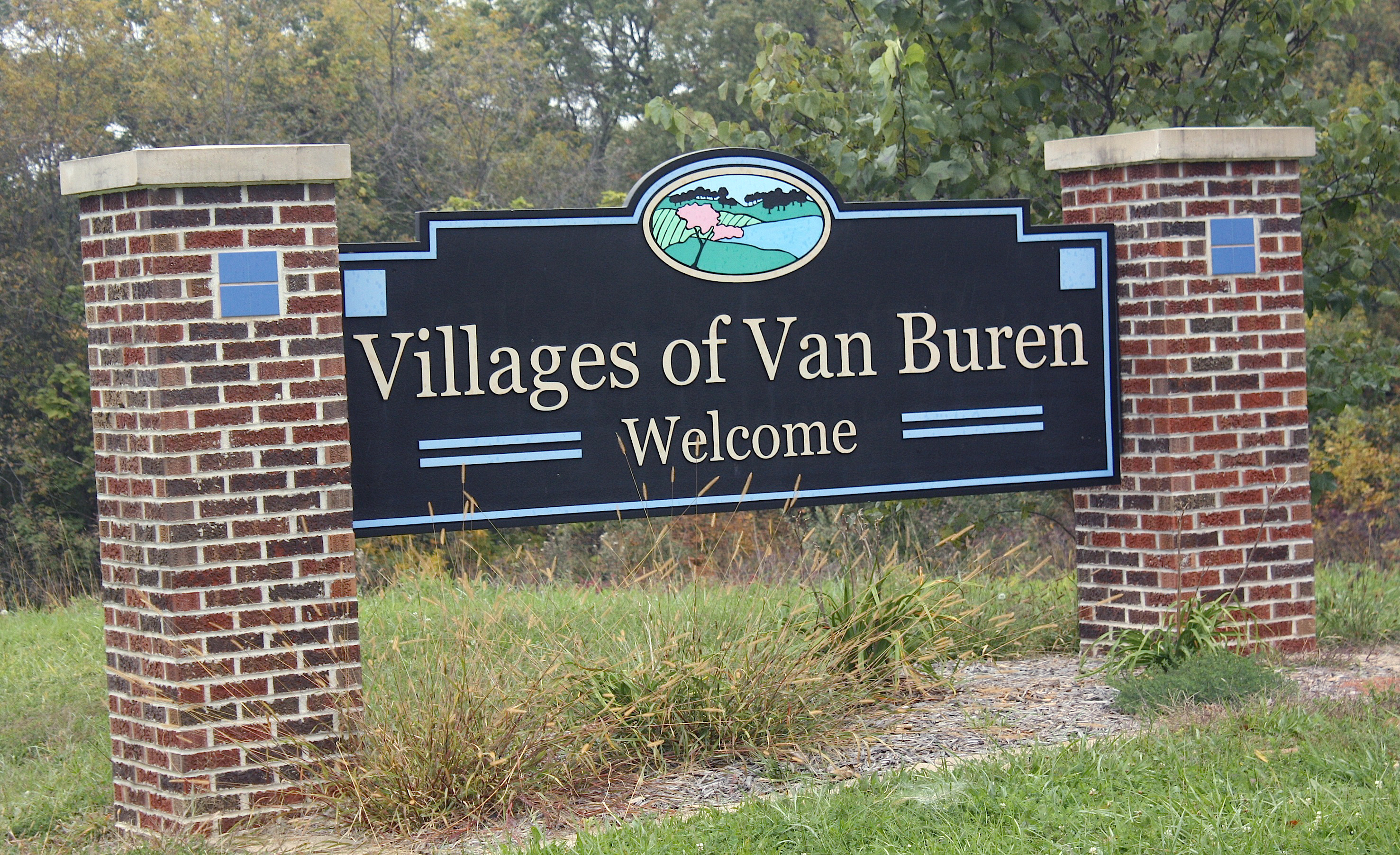
I sort of combined the Villages and the scenic byway and tried to hit the best of both in about 24 hours. I didn’t see everything, but I did the best I could, and I had a lot of fun trying.
So here goes: The western edge of the Historic Hills Scenic Byway starts in Moravia, a good two hours away from my home in Ames. And I had to work Saturday morning, so I didn’t get started on the byway until 2 p.m. (If I had one thing to do over again it would be to get a very early start on Saturday, because a LOT of good stuff in this area are closed on Sunday.)
I’d been to this part of the state before, when I was covering RAGBRAI for the magazine back in 2003 (and another trip or two to visit a friend who lived in Keosauqua). My memory of the RAGBRAI route was that it was hilly and beautiful, that the towns were very small, and that Bloomfield had a mighty pretty courthouse. Other than that, most things looked completely different back then – which isn’t surprising, since it was 11 years ago and there were 10,000 bicycles everywhere I went.
From Moravia, the route is county road J3T to Drakesville, with one or two pretty views along the way. I remembered Drakesville for its split street around the tiny town center – and for its Amish culture.


My first stop was at Rysdam Pumpkin Patch, where I talked to Mark Rysdam. He’s not much of a businessman – he sells everything on the honor system (“Just put money in the jar over there on the table”), but he more than makes up for it as a grower. He told me he planted 70 varieties of pumpkins, gourds, and squash. I bought a yellow pumpkin from him – I’ve never seen one quite that color. He said that earlier in the season he grows sweet corn and tomatoes.
I was back on the road for about two seconds when I saw Hershberger’s Bulk Food and Groceries, an Amish store with a horse and buggy out front and Amish children across the street. I stopped – I hadn’t taken the time to eat either breakfast or lunch – and walked through the aisles of bulk foods before choosing a $2 bag of trail mix to munch on in the car.
But I had again no more than pulled back out onto the road than I spotted my next stop: the Bakery Barn. This tiny Amish-run shed was filled with the most delicious-looking pies and cookies and bread and caramel pecan rolls. For $1.25 I walked away with four freshly baked cookies that I bought from a barefoot girl in a blue cotton dress.
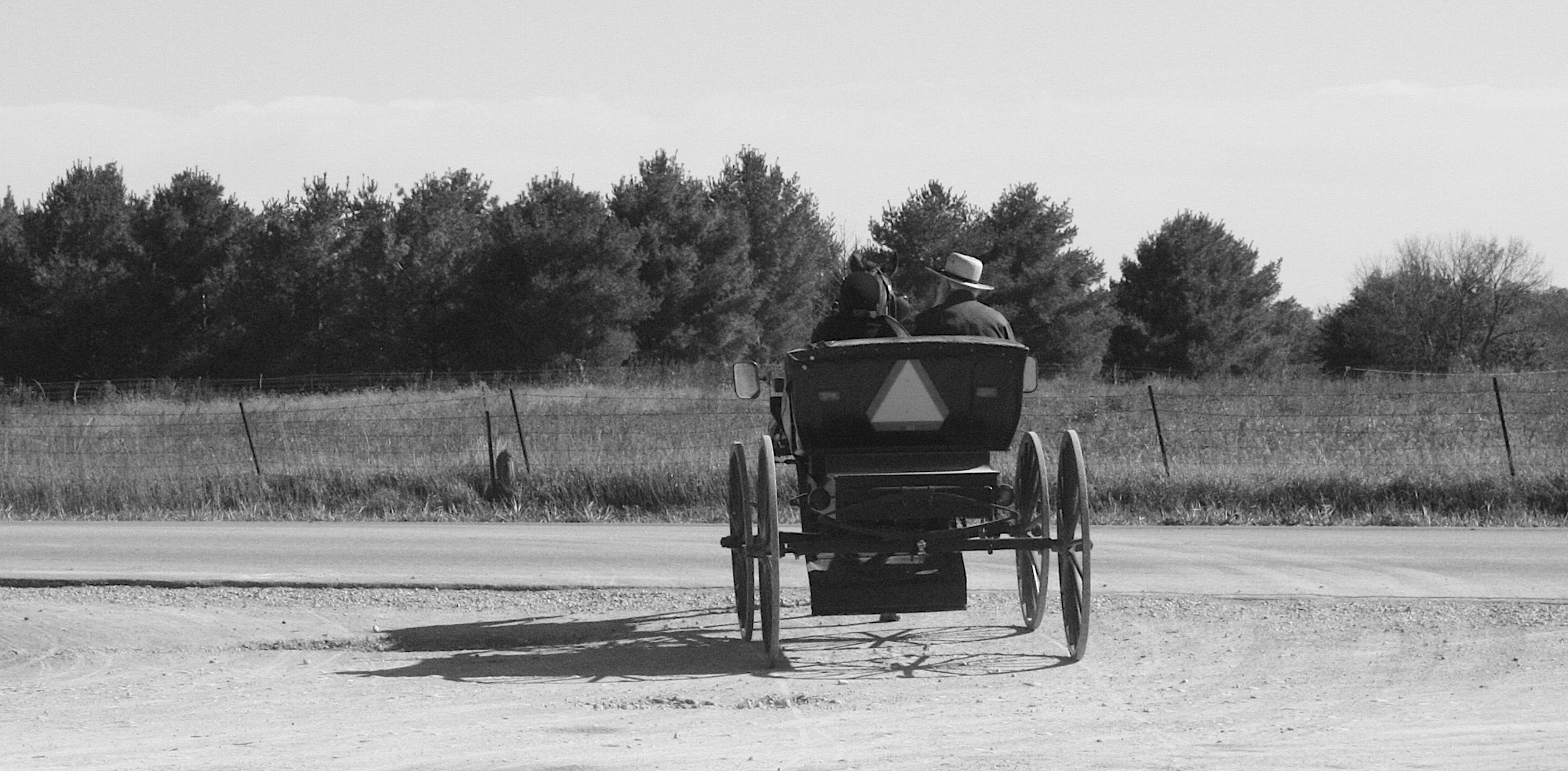
I know the rules about photographing the Amish, but it’s so hard not to take pictures of people who look so wonderfully simple and old-fashioned. I snapped a couple of images of the buggies from a distance and hoped it wasn’t rude. Throughout the weekend I probably encountered a dozen horse-drawn Amish vehicles on the county roads. Drakesville clearly has a large population of Amish farmers and craftsmen – there are signs for shops at each gravel road off the main byway. The Register article mentioned that you can get a map of these businesses, but I didn’t know where to find one. (This is not Kalona, and definitely not the Amana Colonies. Promotion is at a minimum here.)

From tiny Drakesville, J3T takes you to U.S. 63, which leads you to Bloomfield. Bloomfield is a real town, population 2,640. It’s the county seat of Davis County and has the aforementioned pretty courthouse and a nice town square. It was an overnight town on the 2003 RAGBRAI route, and I can still clearly remember the tents and bicyclists all over the courthouse lawn and the nearby schoolyard.
After Bloomfield I left the Historic Hills Byway for two reasons. First, the damn road was closed (same problem that I had on the Loess Hills Scenic Byway!) and second, I wanted to get to the Milton Creamery before it closed.
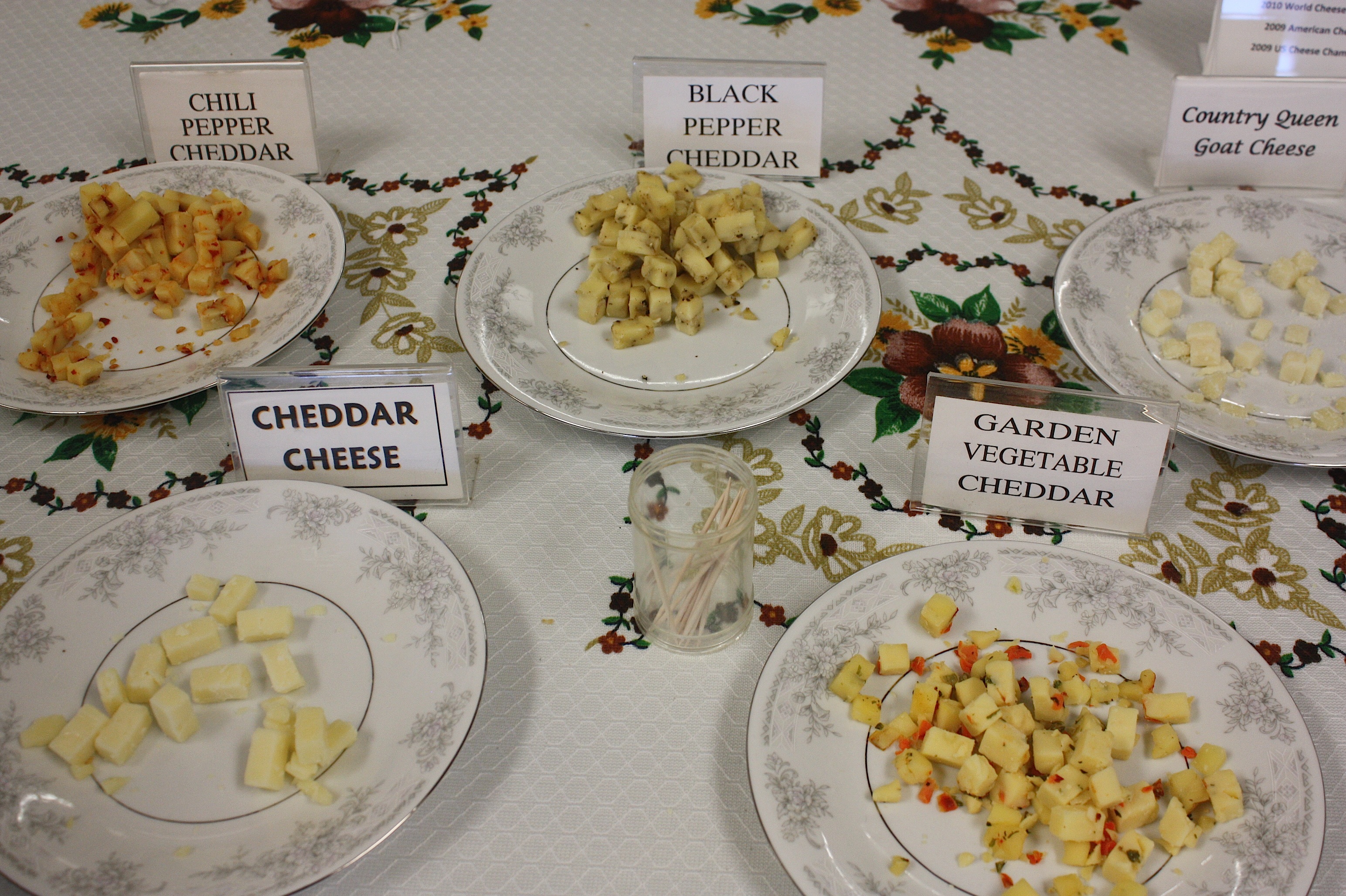
I took Hwy. 2 through Pulasky to Milton. The Milton Creamery is located right on the highway in a big, nondescript pre-fab building. Inside there were samples of about a dozen kinds of cheese curds (smoked, tomato-garlic, chive, chili pepper, pizza, dill) and a variety of cheeses: flavored cheddars, Colby, and the popular Prairie Breeze and Prairie Rose. I’ve heard about this cheese and was eager to try it. I tasted a lot of different ones and chose two bags of cheese curds and a chunk of Prairie Breeze.
At this point, if you’re following along on a map, you see that you’re only about three miles from a town called Cantril. Why I didn’t just go those three miles is a mystery to me, because by not going to Cantril I missed out on shopping at Dutchman’s Store.
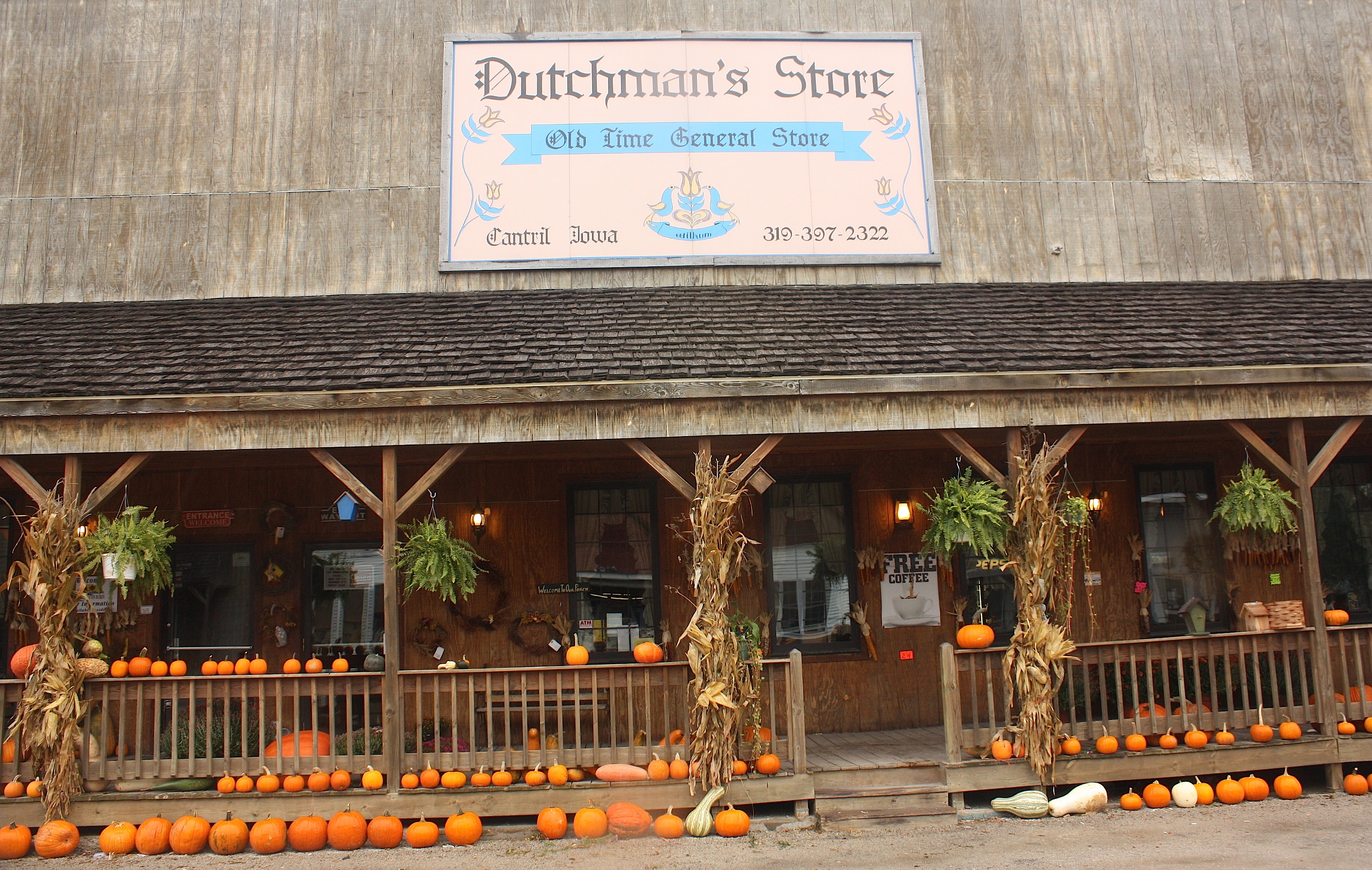
Dutchman’s Store, I now know, takes up a full city block (if you can call Cantril – population 222 – a city, which it is not) and carries bulk foods, baking supplies, shoes, books, sewing supplies, baked goods, clothes, kitchen wares, and grocery items – pretty much everything you’d need if you lived in Van Buren County, because there are no Walmarts here (which is a good thing). At Dutchman’s, you can pick up an Amish-made hickory rocker for $128, a hand-made rug for $26, or an ice cream cone for 50 cents. The store also has a gazillion pumpkins and ears of Indian corn and wreaths and other fall decorations just sitting out on the front porch.
I really do try to do my research before I embark on these little journeys, but I totally missed this one. I really wish I’d gone on Saturday afternoon, even if it turned out to be a total tourist trap, and even though I heard it was crazy crowded with the Fall Drive Festival people. I still wish I had gone. And, of course, like everything else in this county, it’s closed on Sunday.
Instead of going to Cantril, I stupidly turned around and headed back toward Bloomfield to find the detour that would get me back on county road J40, part of the Historic Hills byway that takes you to Troy (I have a great story about RAGBRAI stopping in Troy for breakfast, but I’ll spare you), through tiny, unincorporated Lebanon (with more Amish businesses), toward Keosauqua.

I wanted to visit Lacey-Keosauqua State Park today. In my planning I found that there was to be a “fun run” in the park on Sunday morning, and I wanted to avoid that. In fact, I figured I couldn’t even drive through the park on Sunday because of the event. So I went there late Saturday afternoon. There was something called a Buckskinner’s Rendezvous Camp going on – a scary, manly-looking thing – and there were a lot of tents and RVs. But the main park road was open and the trees were all turning gold.
The entrance to Lacey-Keosauqua is right across the Des Moines River bridge from the town of Keosauqua. This is the county seat and the largest town in Van Buren County. Its population is 1,066. (In the 2010 census, the whole county only had a population of 7,570.)

The view as you enter Keosauqua – with the bridge and the river and the little town nestled on the riverbank – is made more dramatic with the presence of the 115-year-old Hotel Manning. This is where I spent the night.
When I made my reservation the week before, the hotel was all but sold out. Of the 16 rooms (8 with private baths), only one room remained – a room with a twin bed and shared bath. Knowing that the Hotel Manning was pretty much the only game in town (or county, as it were), I booked it. The cost: $50.
When I got to Keosauqua at about 5 p.m., vendors in a large flea market/food truck area were just starting to pack up for the night. I didn’t mind missing this, but the presence of all these additional people (and not a small amount of road construction, on top of it) made it rather difficult to get to the hotel. The road I should have gone down was barricaded for the event. The next road was blocked with construction. I tried to go around the back way but there was more construction. Finally, I went down the original road, driving between the barricades, and parked illegally in front of the hotel. I later heard a local man say he’d never seen so many cars in Keosauqua.
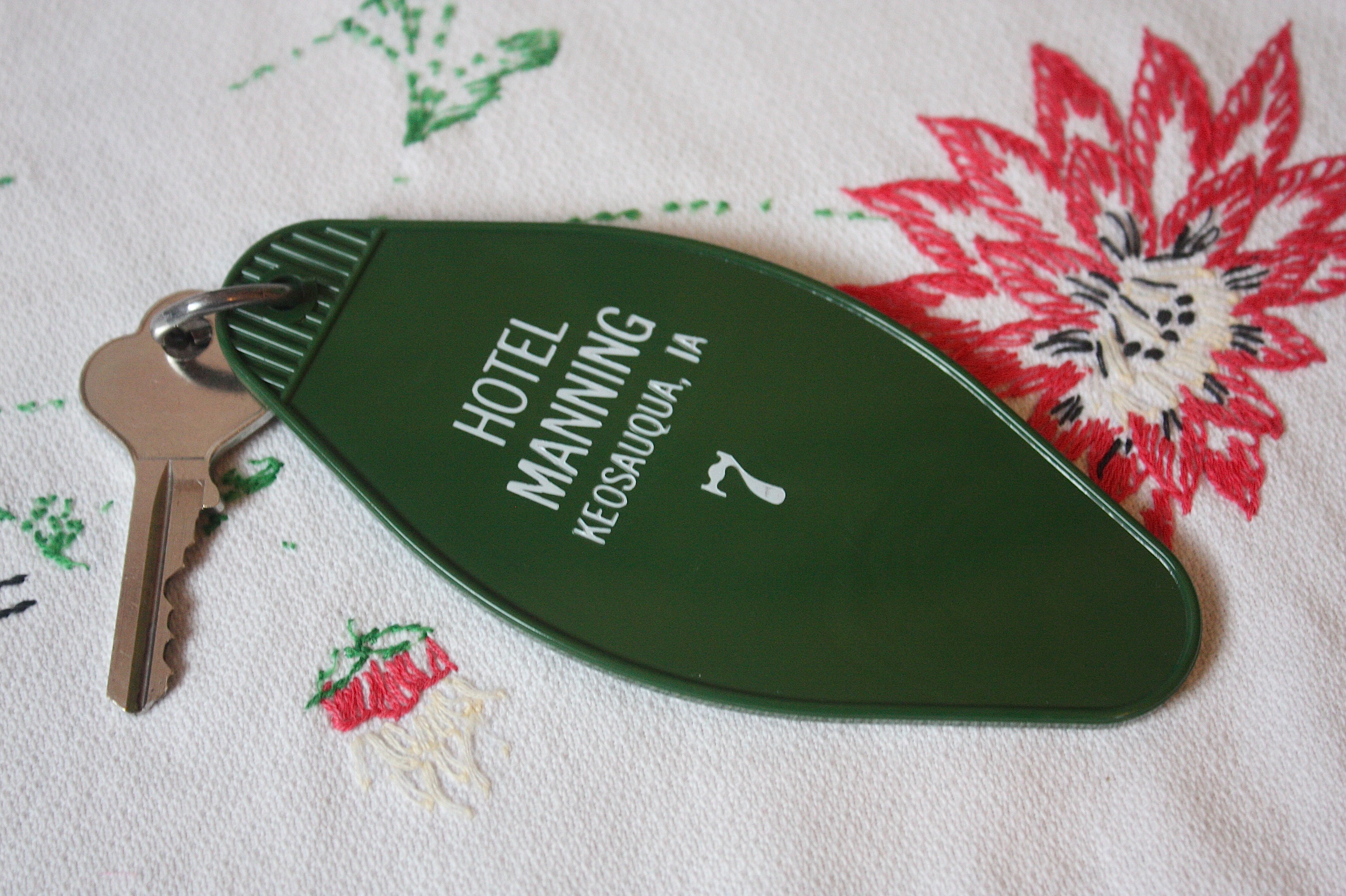
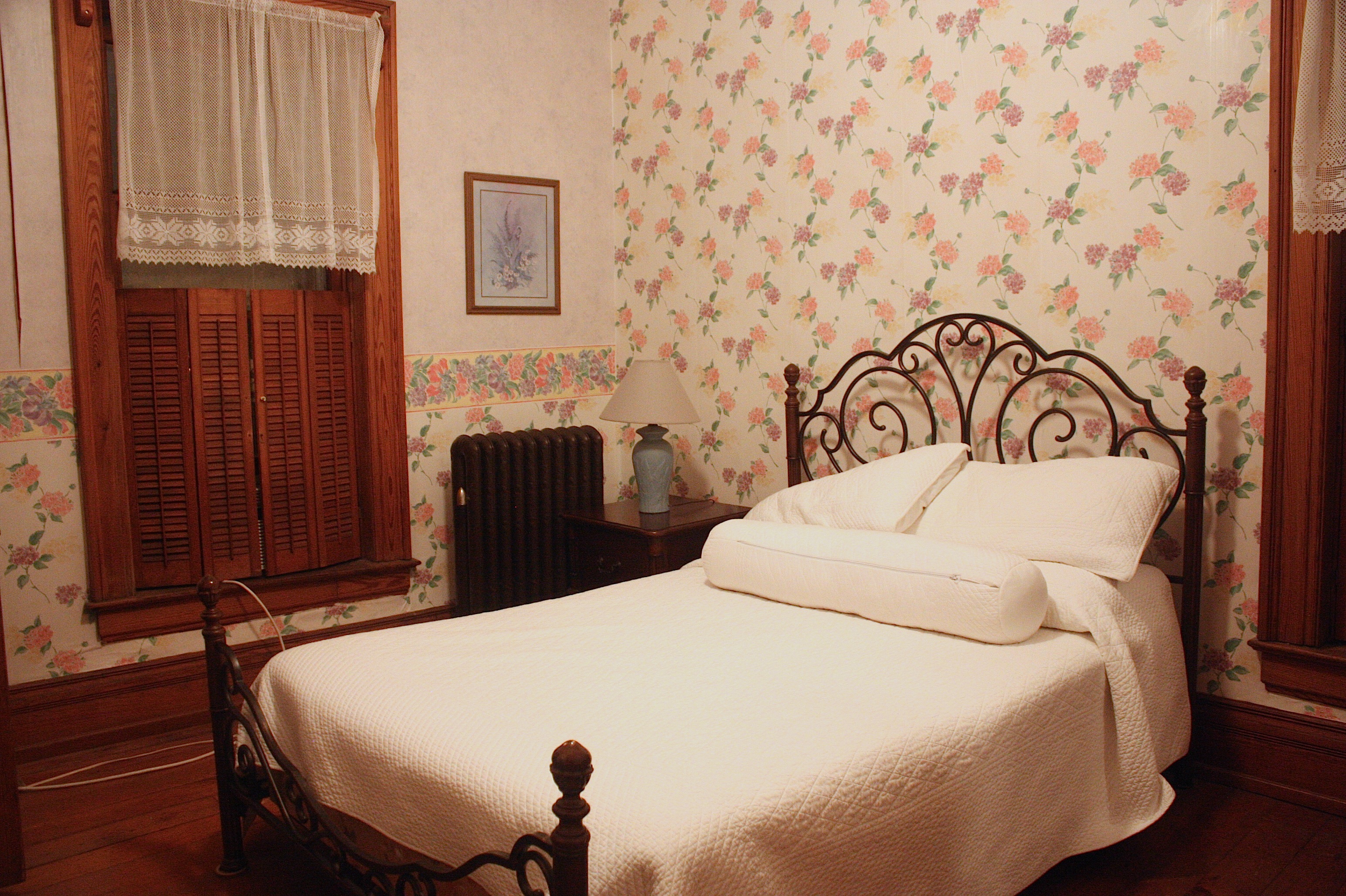
I entered the empty lobby, rang the bell at the front desk, and an elderly man emerged to check me in. As luck would have it – and I really can’t believe just how lucky this was – someone had cancelled a reservation for a room with a queen-size bed and private bath. Would I like to upgrade? he asked. Heck, yeah! So for $25 more I got a cute little room with absolutely no modern amenities – no television, no phone, no alarm clock, no wi-fi, no hair dryer – with antique furniture, creaky floorboards, and a radiator that made noises straight out of a horror film. I loved it.
Once I got checked in, I walked through the downtown and found a number of bars and a couple of restaurants. I stopped first at the Town and Country Tavern, right across from the VFW. It was rather busy, with a mix of locals, vendors, and tourists. I found a seat at the bar between an odd couple from Burlington and a large man with a broken arm. My guess is he fell out of a tree while hunting. Or maybe I just think that because he was wearing an orange vest and a camouflage jacket. There were the usual televisions turned to all things sports – yes, it’s that magical time of year where you can watch baseball and football at the same time – and there was a lively discussion around the bar about a poster of Pamela Anderson in the men’s room.
But the tavern had a decent selection of beer, and I found the bartenders and clientele quite entertaining. I drank two Sam Adams Oktoberfests before moving on to find some supper.
The Riverbend Pizza and Steakhouse was kind of a disappointment after the bar. I ordered a calzone and tried to people-watch, but it was pretty boring.
My night in the Hotel Manning was mostly uneventful. The historic hotel is said to be a classic example of Steamboat Gothic architecture. It was built in 1899. I think it’s a really special place, and I’m really glad I stayed there. I’m also really glad that I never travel without sleeping pills, because that radiator would have kept me up the whole night.
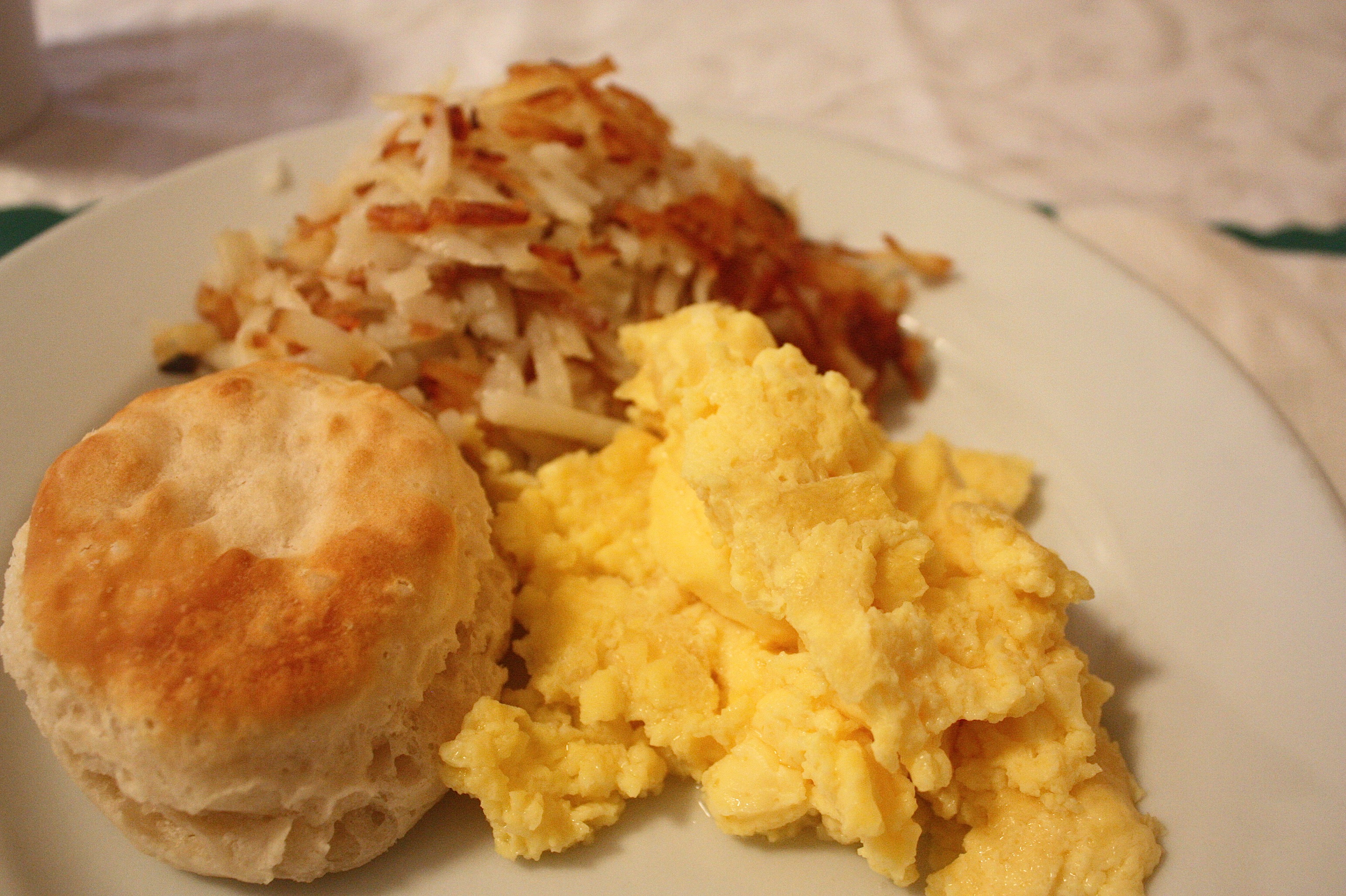
The next morning hotel guests were expected to go through the free hot breakfast buffet between 8 and 8:30 a.m. After that, the restaurant would be switching over to a large Sunday brunch. I was fine with that, because I wanted to get on the road. Breakfast consisted of biscuits (with gravy, if you like that sort of thing), buttery scrambled eggs, hashbrowns, and a few other items that I didn’t try. The basics were very good indeed. And a server brought around coffee.


I left Keosauqua at around 8:30 under cloudy skies and continued on J40 to Bentonsport. This is a great little historic town with an old (now pedestrian-only) river bridge built in 1882, a couple of historic B&Bs, pretty churches, and a historic district that contains antiques shops and a museum. I walked across the bridge and back. A small group of antiques dealers and food vendors were just starting to set up for a 10 a.m. opening of the antique show along the main street. It was chilly out. I bought a cup of coffee from a nice man and his grandson in a food truck, and I visited with one antique tool seller. I asked him why he chose to set up in Bentonsport when there was a show in Keosauqua and another in nearby Bonaparte and he just said simply, “This is the place.” It did appear to be a small but high quality group of antiques dealers.
At this point it started to rain. I drove to Bonaparte, another wonderful, small historic river town.

Bonaparte has a series of mill buildings. The pants factory, built around 1892, is now home to the Bonaparte Inn. The grist mill houses the Bonaparte Retreat Restaurant. There’s also a woolen mill and the Bonaparte Pottery archaeological site. The whole area is designated a National Historic Riverfront District. According to one brochure, Bonaparte is the smallest Main Street Community (population 465) in the United States.
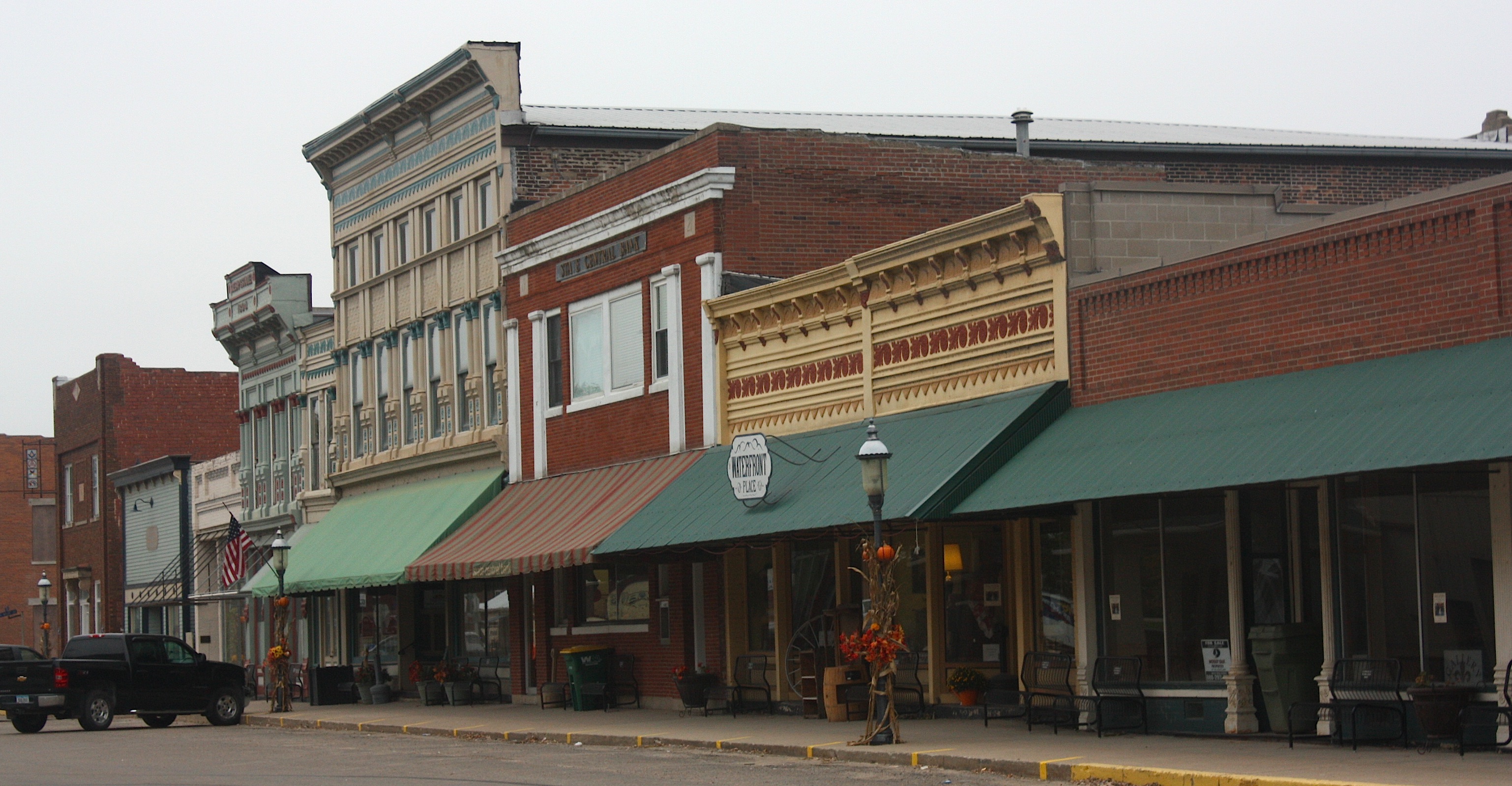
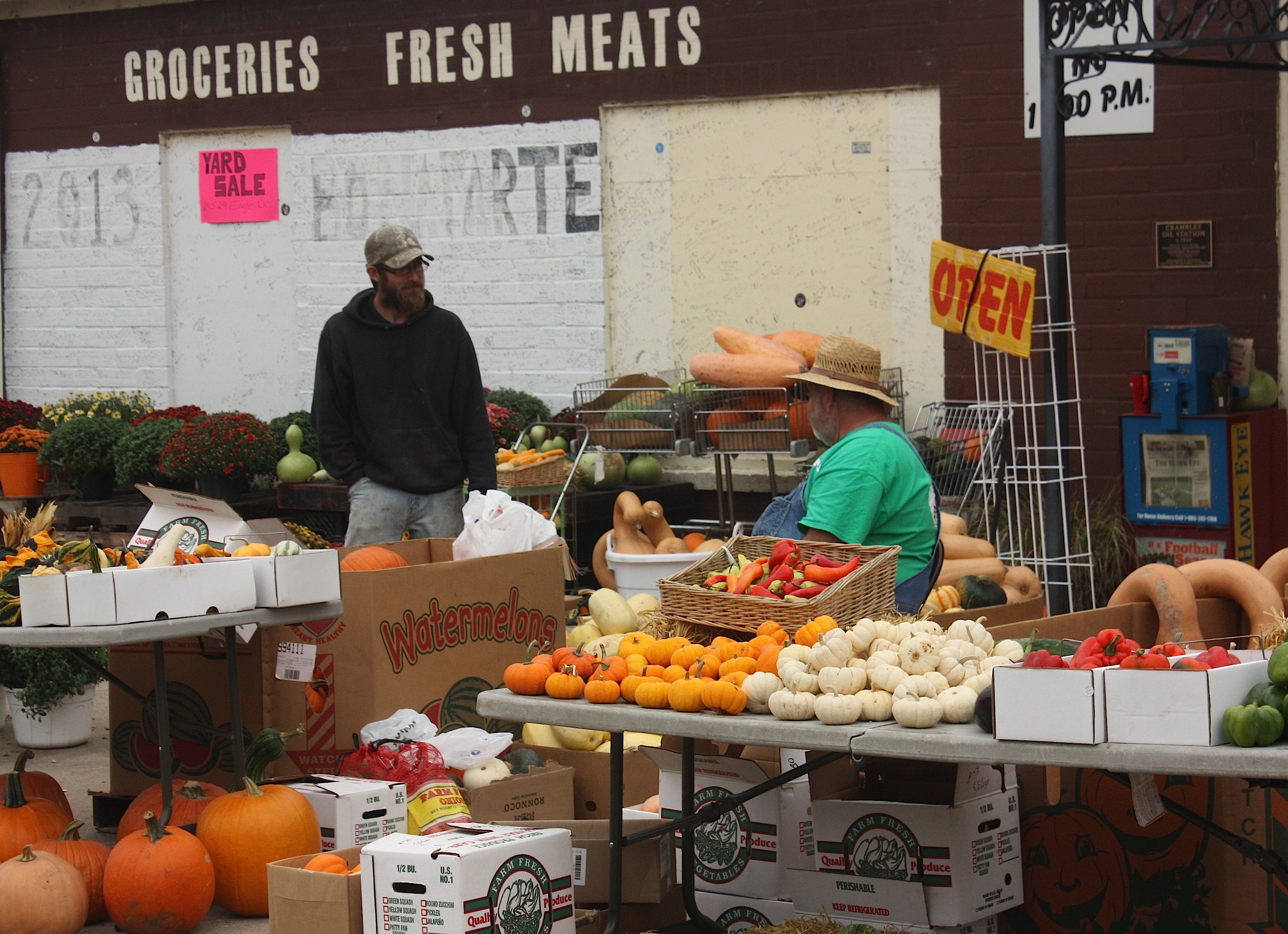
Since I was there on Sunday morning, there wasn’t much movement along the main street. I enjoyed the historic buildings, visited one antiques shop, and walked past a vendor selling pumpkins and baskets of mums. In the city park along the river, there was a small group of vendors making up a sort of flea market for the Fall Drive Festival.
From Bonaparte I drove along Hwy. 2 to Farmington and then Donnellson, where the Historic Hills Scenic Byway ends.

Based on Mike Kilen’s recommendation, from there I drove some of the gravel roads through the Shimek State Forest and saw the prettiest fall color of the whole trip.
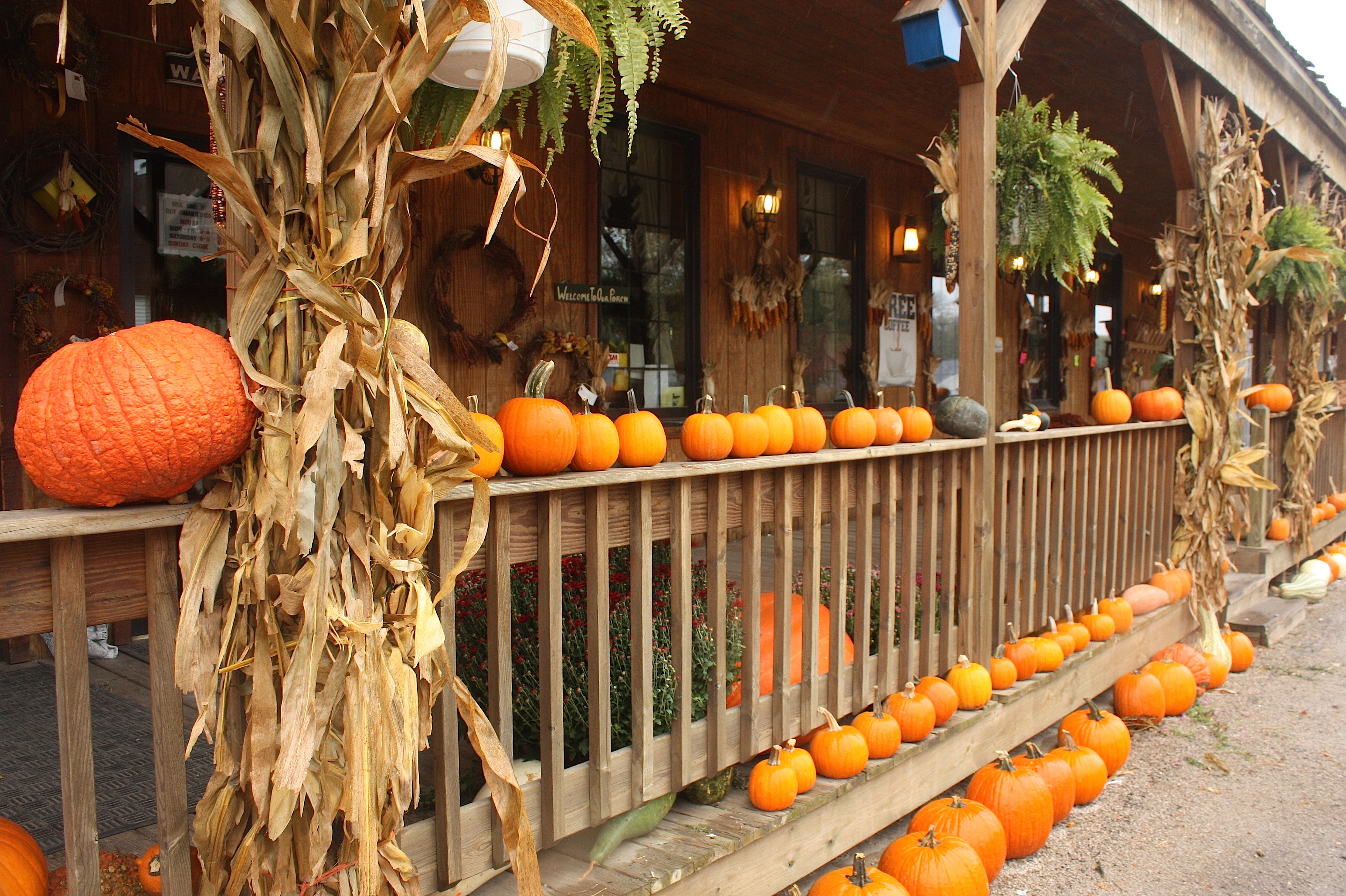
It was still raining. I drove Hwy. 2 west through Cantril, where I stopped to take pictures of the outside of Dutchman’s Store. On my way out of town, I saw a group of Amish families in their Sunday clothing standing outside their house of worship. That was a truly memorable scene.
Hwy. 2 takes you back to Bloomfield, and if you follow the scenic byway up to Drakesville, the tiny Amish community where I bought my cookies and yellow pumpkin yesterday, there’s a fork in the road that leads slightly more north than the route I took to get here. This is also a part of the Historic Hills Scenic Byway, and I wanted to drive it to its end in Blakesburg. This is a very scenic part of the byway and also the most surprising – it’s a gravel road. But you should drive it anyway.

HERE ARE MY TAKEAWAYS from my 24 hours in Van Buren County and along the Historic Hills Scenic Byway: This is an area of the state that’s a long, long way from an interstate highway, and although its history and beauty and architecture and culture rival (if not best) the Amana Colonies, it suffers a bit from its lack of marketing and from its location. But in a way, I think that makes it more special. It feels more real.
If I had to do this weekend again, I would not go during the Fall Drive Festival, because it really didn’t add anything I wanted to see or do, and it just made for some extra tourists, something I prefer to avoid. I’d stay more than one night, try to visit some of the museums, spend more time in Bonaparte and Bentonsport, definitely go to Cantril when Dutchman’s is open, drive up to Stockport and over to Douds, and take the historic barn tour. I’d do more research of the history of the area. I feel as though I just scratched the surface.
Oktoberfest in Amana

It’s October! And you know what that means: Oktoberfest celebrations all across the state of Iowa. But what could be more authentic than Oktoberfest in the Amana Colonies, a group of villages settled by Germans in the mid-1800s?
The Amana Colonies consists of seven villages: Amana, Middle Amana, High Amana, West Amana, South Amana, Homestead, and East Amana. In each of these small towns you can see the brick and stone buildings constructed when the Germans first settled in the area.
Amana, the largest town, is known for its festivals – Winterfest, Prelude to Christmas, and Maifest to name a few – but Oktoberfest may be the largest and most popular of the festivals. The weather is great, the trees are changing colors, pumpkins are being harvested, and, well, there’s a whole lot of beer.

Oktoberfest was held this weekend in Amana, and although it was a little on the chilly side when I was there on Saturday, with highs only around 50 degrees, there was still a large crowd in town enjoying the music, parade, authentic German cuisine, shops, and, of course, beer gardens.
I arrived in Amana just in time for the parade to begin. I like a good parade, but most parades are too long, too boring, and have too many gaps.

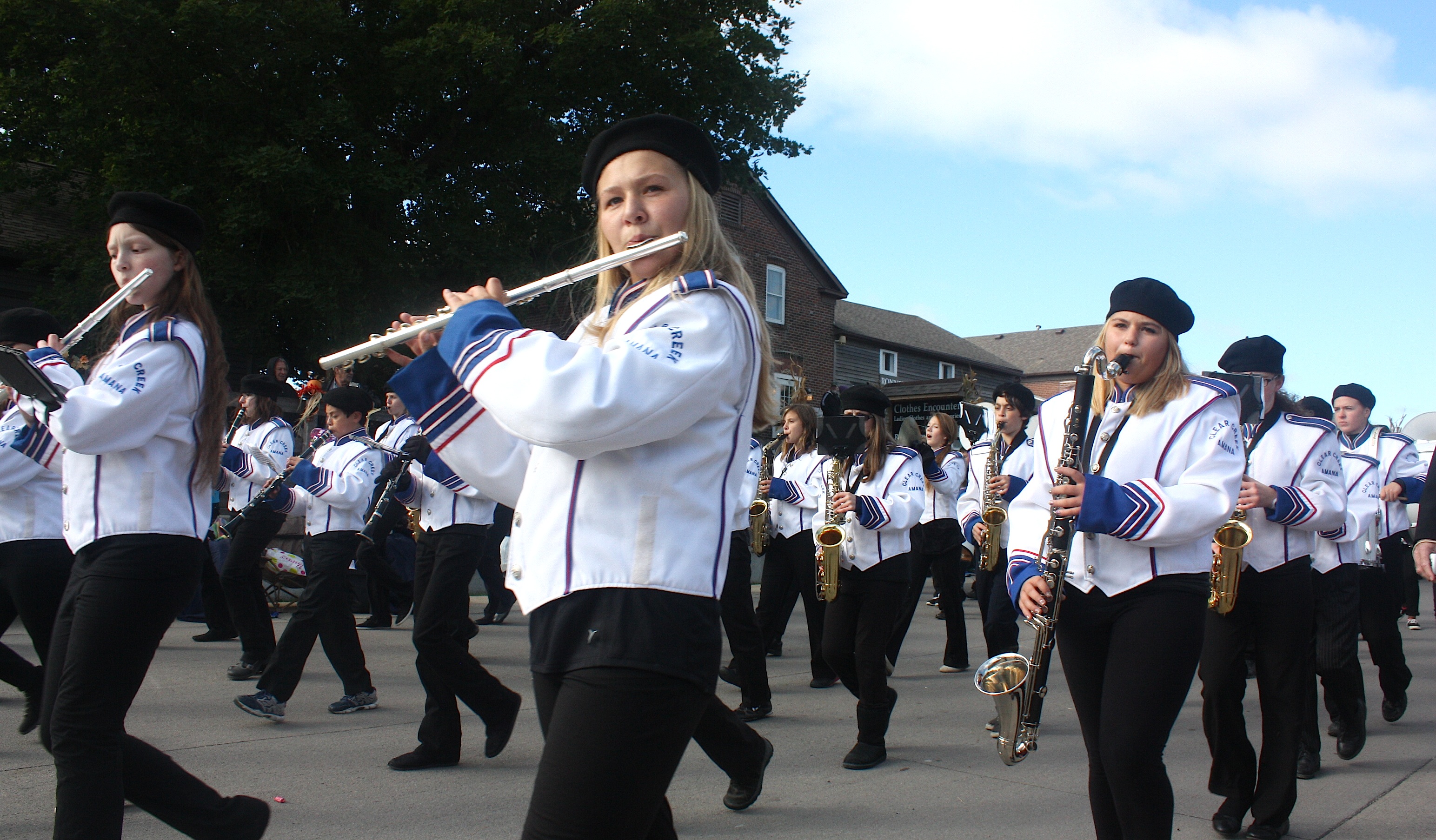
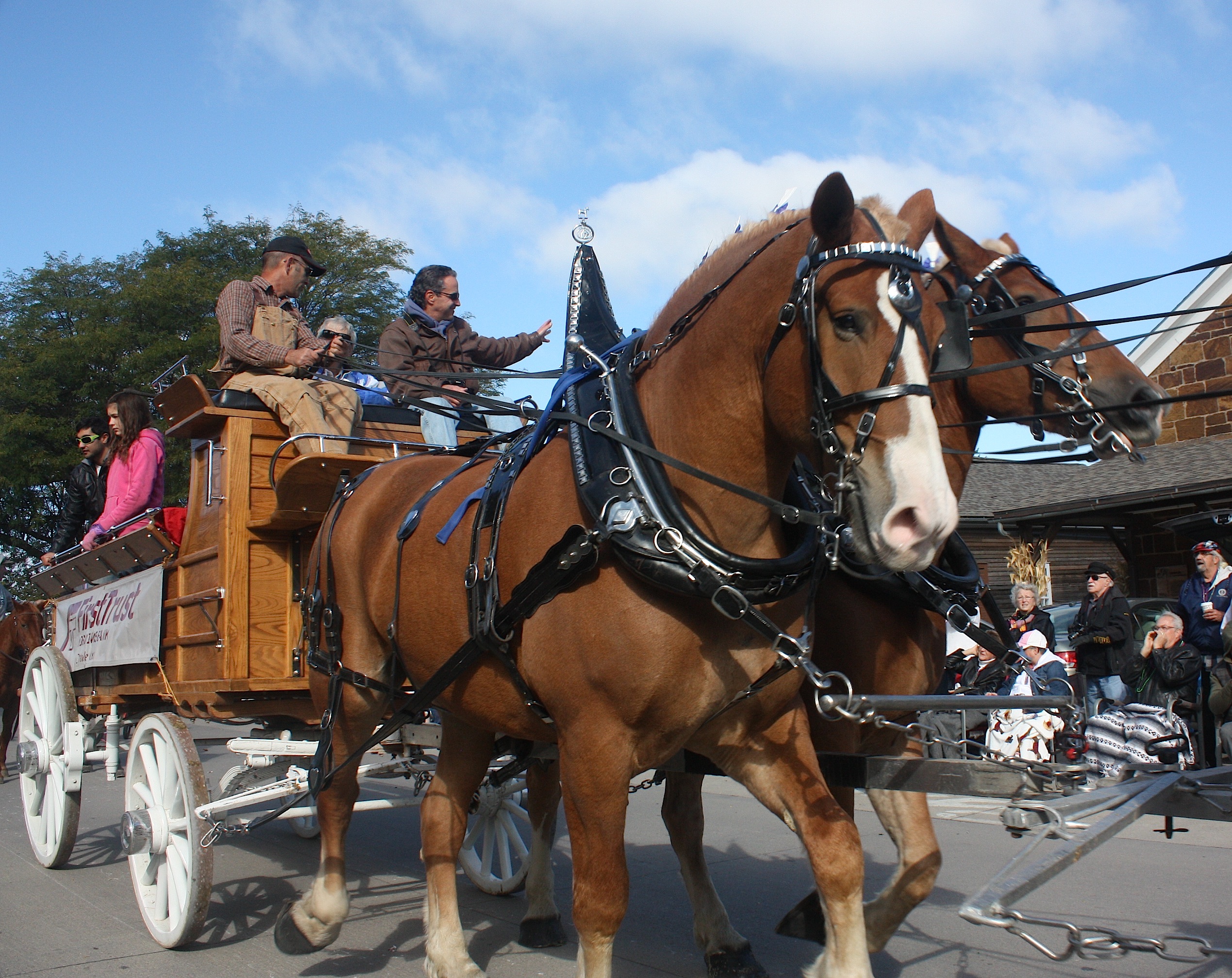
I was pleasantly surprised by this parade – it was fairly brief but had all the good stuff a parade should have: marching bands, floats, horses, goofy local stuff, and a queen. I will forgive it for the political entries because overall it was very well managed.
After the parade ended I was hungry and headed for the nearest restaurant on the main street: Ox Yoke. I’ve eaten here before and didn’t love it, but I figured they’d still be serving breakfast because it was just a smidge after 10:30. But not only were they no longer serving breakfast, they weren’t serving anything at all. Seating for lunch apparently begins at 11 a.m. We opted instead for the Ronneburg Restaurant, which serves authentic German food. Of course, that means it’s not vegetarian-friendly, but the server assured me the salads and sides would fill me up. I ordered a green salad (a large plate of mixed lettuce with boiled egg, tomatoes, cucumber, olives, and blue cheese dressing), a piece of coconut-cream pie, and a cup of coffee. The service was friendly and the atmosphere was pleasant enough.

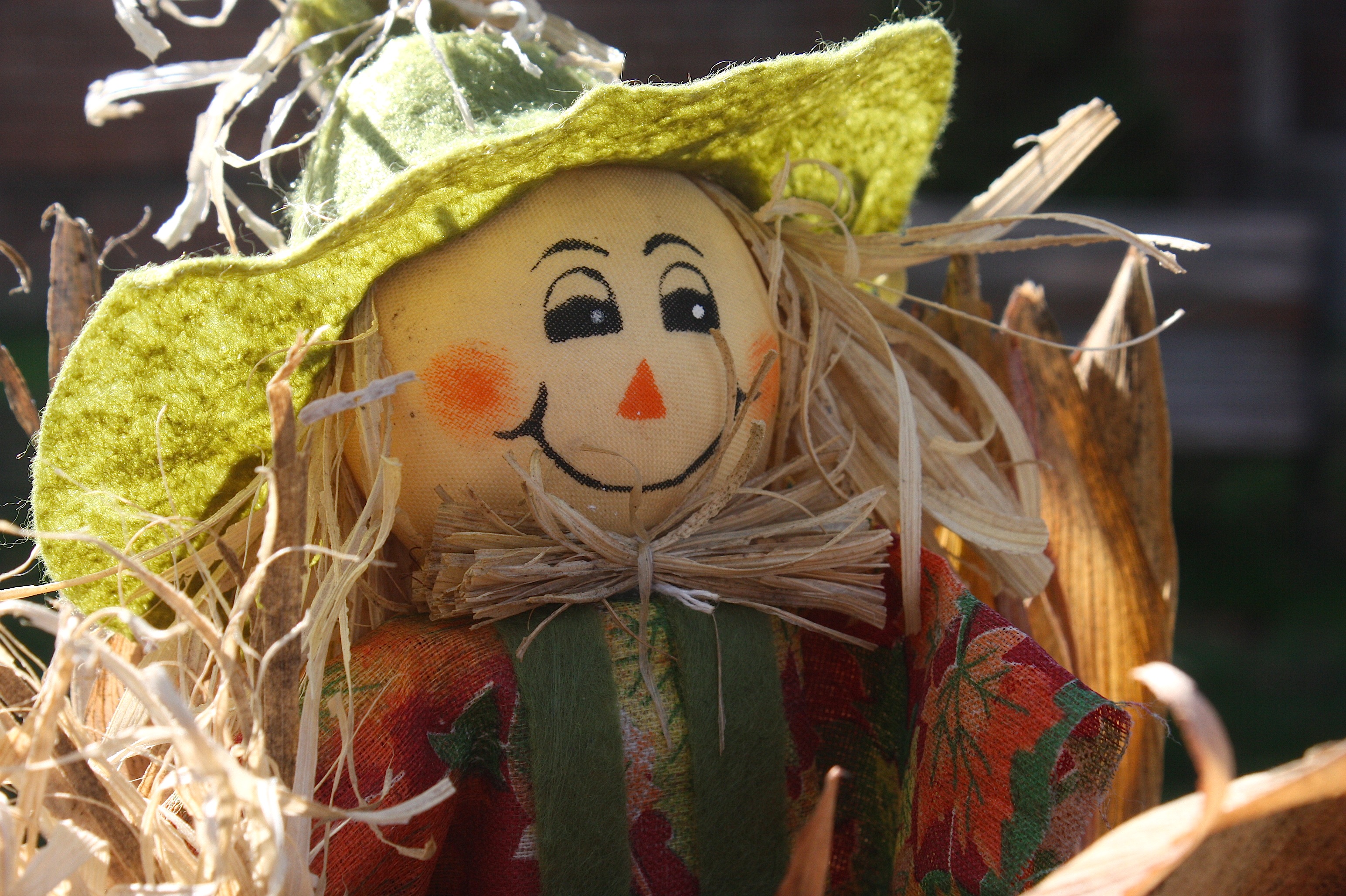

Back outside, all along the main street, bands were playing German beer-drinking music, people were helping themselves to beer and brats, shops were giving out samples of fudge, and the whole town smelled like kettle corn. Pumpkins, Indian corn, and scarecrows were everywhere. I do love fall.
For those who were interested, bands played a variety of music all weekend at the Festhalle barn (for an entry fee), you could take a ride on a horse-drawn carriage for $5 per person, and there were a number of demonstrations and tours. We did none of this.
We headed instead for Millstream Brewing Company, Iowa’s oldest craft brewery. Even at noon the place was hopping, with cold draught beer being poured inside and out, plus polka music and a long line for brats.
We were lucky to get seats at a large shared table and enjoyed a couple of Oktoberfest beers while listening to a band consisting of an accordion and a tuba. Gotta love that. We also bought a six-pack of Millstream Oktoberfest to bring home. I look forward to this beer every year.
After leaving Amana we drove to a few of the other villages along the 17-mile Amana Colonies Trail loop. The farmland in that area is just lovely, and the small villages each have something to draw visitors: mostly museums, shops, art studios, and B&Bs. The Broom & Basket Shop in West Amana is said to have a giant rocker, but I didn’t stop to check it out.
I did make a stop at Fern Hill Gifts & Quilts in South Amana, and it’s a destination I would highly recommend to anyone who enjoys shopping for home décor, seasonal decorations, quilts, and gifts. The shop also had pie and fudge.
Check out all the Amana Colonies’ events here. The next big festival is Prelude to Christmas Dec. 5-7.
Octagon Arts Festival
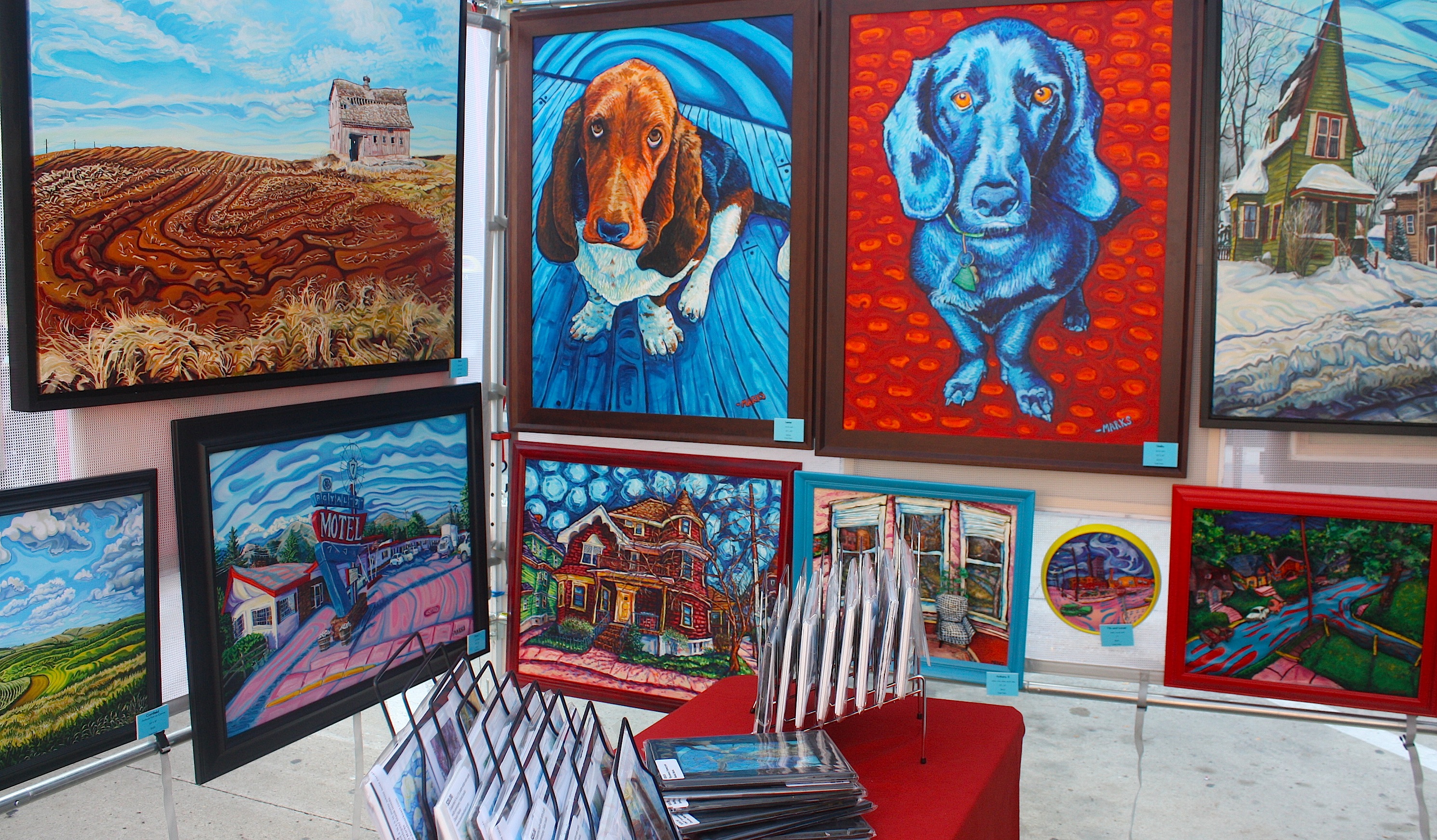

Last Sunday’s weather was just perfect for the 44th annual Octagon Art Festival in downtown Ames. More than 90 artists exhibiting painting, ceramics, glass, photography, textiles, metal, sculpture, jewelry, wood working and more lined Main Street. Adding to the festive atmosphere were musicians, food vendors, and art activities for the kids. The quality of the art was very good; I especially appreciated the variety of wonderful pottery at this year’s show.
Michigan’s Upper Peninsula
We entered the Upper Peninsula of Michigan late in the day at the northernmost road connecting with Wisconsin. Our journey was about to begin.
I’d pondered the wilds of the UP for nine months since a conversation with two of my colleagues at a holiday party. Both had grown up in Michigan and knew the lakeshores, backwoods, cliffs, small towns, waterfalls, hiking trails, shipwrecks, and lighthouses that make up the Upper Peninsula. I was immediately smitten with the idea of making this one of my next vacations.
So I bought a book – Michigan’s Upper Peninsula by Paul Vachon – and unearthed a clipping I’d saved from the New York Times called “My Upper Peninsula” by Jim Harrison, author of Legends of the Fall.
Still winter, with resources in hand, I plotted our itinerary. We’d go to the Keweenaw Peninsula, the upper fin on the fish-shaped landform. We’d go through Marquette, the only city of any size in all the UP. We’d visit Pictured Rocks National Lakeshore and Tahquamenon Falls State Park. We’d venture into Canada via Sault Ste. Marie, take a ferry to Mackinac Island, and drive across the Mackinac Bridge to the Lower Peninsula.

I learned that the UP is about 30 percent of Michigan’s total land mass but contains only 3 percent of its population. The area gets up to 300 inches of snow each winter. It’s surrounded by the Great Lakes: Superior to the north, Huron to the east, and Michigan to the south. Although it’s firmly connected to Wisconsin, the UP never touches the rest of Michigan – you can only reach the UP from the Lower Peninsula by bridge or ferry. The natives are called “Yoopers,” and the tourists who travel to Mackinac Island are called “Fudgies.”
Dave and I determined that we would go to the UP in the early fall, hoping for few tourists and cool weather. We never really considered fall color, though if we would have thought about it, we might have pushed our travel schedule back a couple of weeks. Instead, we booked hotels starting the weekend of Sept. 13, the first non-home Cyclone football weekend (Dave does NOT miss an opportunity to tailgate). We didn’t want to go too late…we’d heard about the area’s early winter storms.
In the end, we spent a day driving to the UP, four full days traveling the area, one day on Mackinac Island, and one day along the Lake Michigan shoreline in the northwest Lower Peninsula before driving home. Here are the highlights:
KEWEENAW PENINSULA
The Keweenaw (pronounced “Kee-wuh-naw”) Peninsula is the northernmost part of the UP. To get there from Ames, we drove north to the Twin Cities and across northern Wisconsin to the towns of Hurley (on the Wisconsin side) and Ironwood (on the Michigan side). After spending the first night in Hurley, we drove northeast on a two-lane highway (our mode of transportation for the next four days) toward Copper Harbor, which is pretty much the end of the road.

Highlights of the drive included the more-or-less-conjoined towns of Houghton (pronounced “HOE-ton”) and Hancock. Houghton is home to Michigan Tech University, and Hancock has Finlandia University. The towns are small, but they’re sort of a population hub in this neck of the woods, and with the colleges they offer a fair number of restaurants, shops, bars, and other services. (We ate lunch at The Library in Houghton. The atmosphere was cool, but the food was just so-so. I did get a good cup of coffee at a coffee shop called Cyberia.)
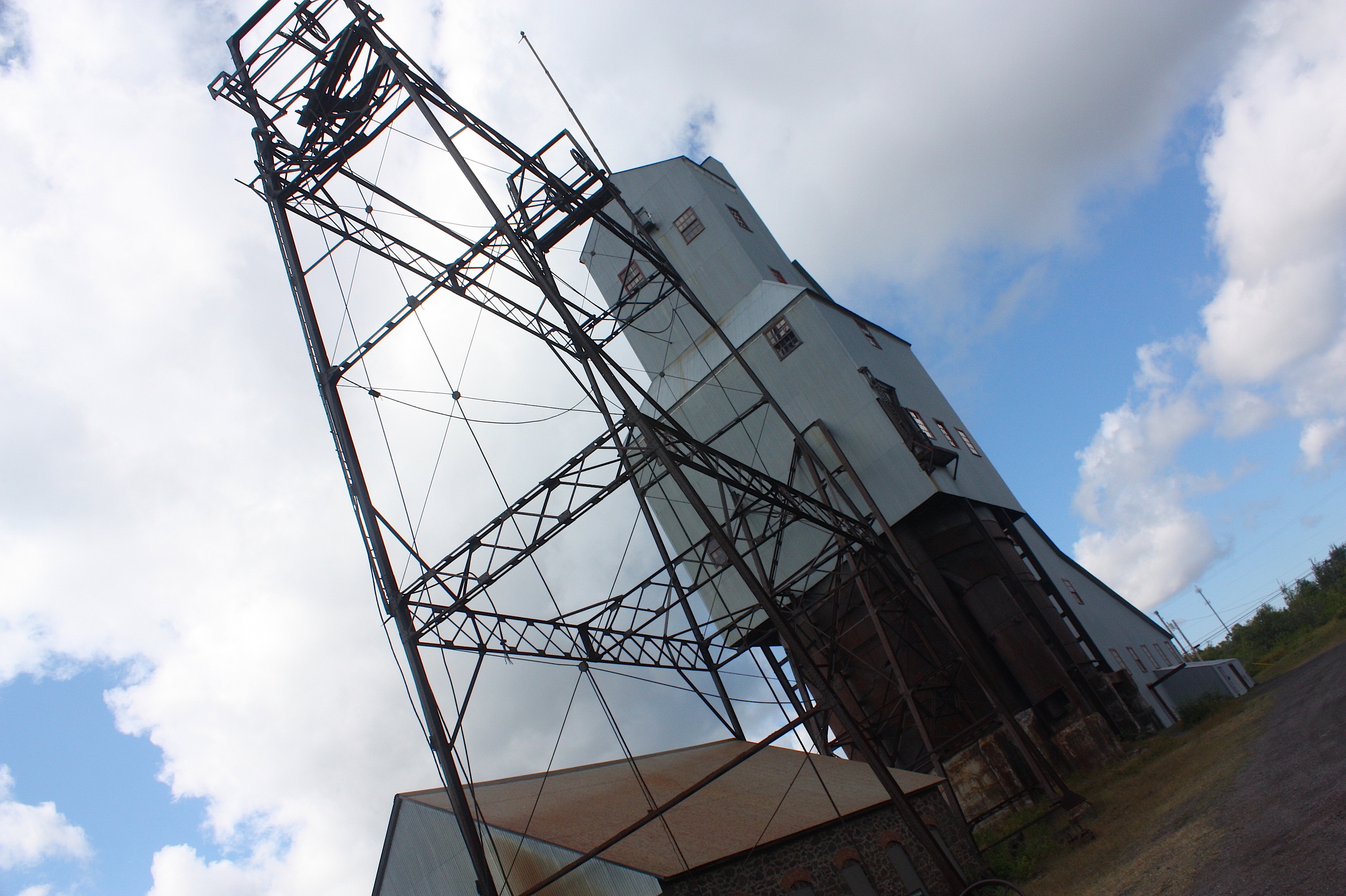
This whole area of the UP is known for its history of copper mining. In Hancock, you can visit the Quincy Mine (below), part of the Keweenaw National Historical Park administered by the National Park Service. (A two-hour tour takes you 2,000 feet into the mine, which is, well, underground, so it was obviously not an option for me, the world’s most claustrophobic woman.)

Another cool thing about Houghton and Hancock is the lift bridge between the two towns (above). The bridge crosses the Keweenaw Waterway, which splits the peninsula in half. The 21-mile portage waterway also allows boaters to cut across the peninsula, saving them a 100-mile trip round the tip. Visitors heading to Isle Royale National Park can board the ferry here, too.
Northeast of Hancock is Calumet (below), a historic mining town with terrific old architecture and several interesting museums, including one run by the National Park Service.


Not long after driving through Calumet, we got off the main road and scooted over to the lakeshore at Eagle River. We were immediately greeted by a waterfall and a lighthouse. Yes! This is what we came to see. I was hoping to stop at The Jampot, a bakery and jam shop in the middle of nowhere run by Byzantine monks. The monastery’s website says the monks “embrace evangelical poverty, chastity, obedience, and stability of life” – and, apparently, the making of dozens of kind of fruity jams and booze-soaked fruitcake-style breads. When do you get the chance to see such a place? Never, that’s when.
So I was completely bummed (but not altogether surprised) that the shop was closed. After all, it was a Sunday afternoon. But we went back the next morning and I bought a loaf of ginger-walnut cake soaked in brandy, plus four jars of exotic-sounding jams. And I got to see a couple of the monks; they totally made me think of Monty Python and the Holy Grail. I wanted to take pictures, but it seemed sort of disrespectful, so I only photographed the outside of the building…and the jam.

We stopped at the Eagle Harbor lighthouse before jumping on the Brockway Mountain Drive, said to be the highest drive between the Rockies and the Alleghenies and also the most beautiful road in Michigan. I’m not sure if I agree with that, but there is one kick-ass overlook (above) that makes the drive well worth it.

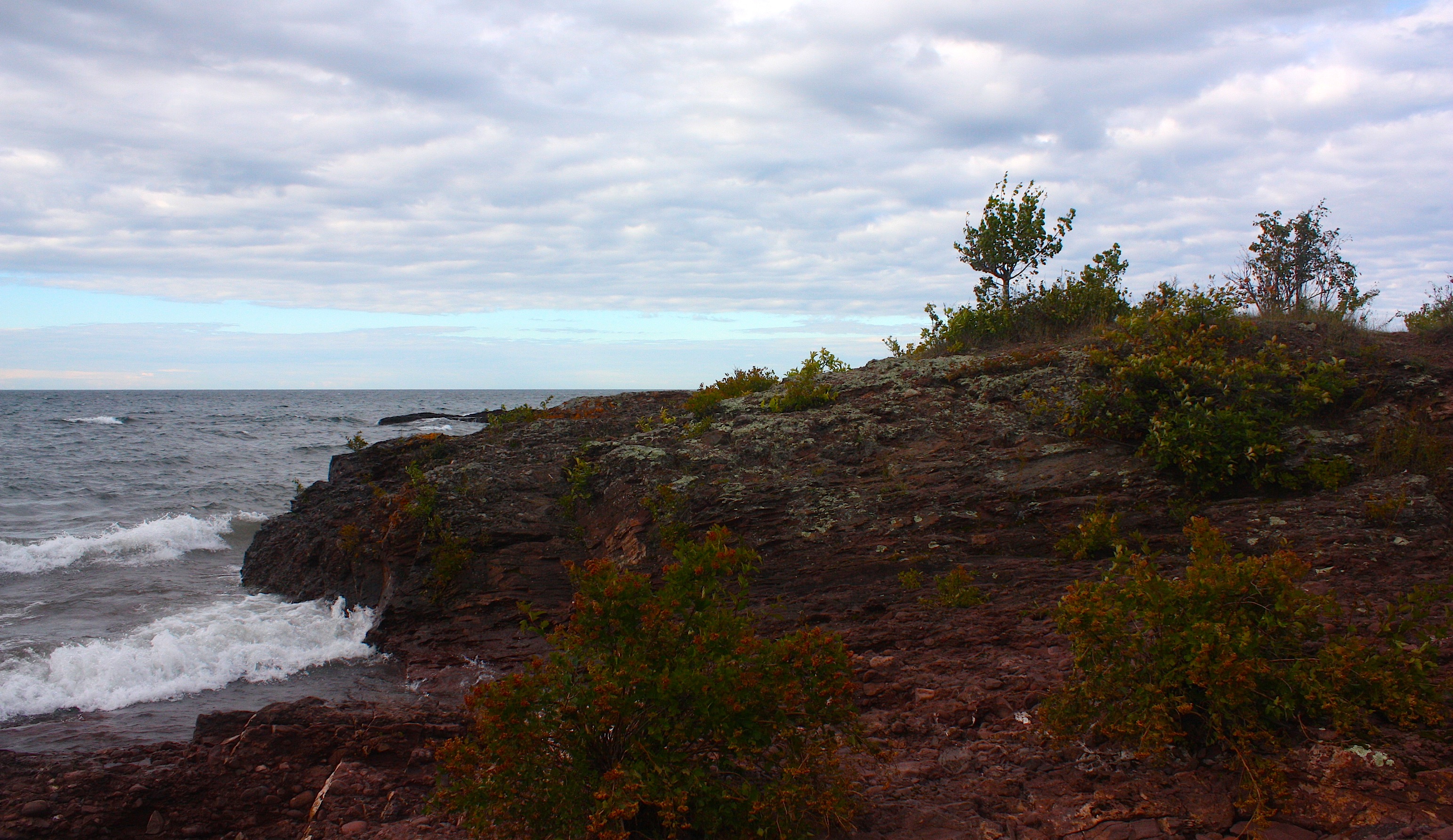
The mountain drive ends in Copper Harbor (above), our home for the night. But we were not ready to settle in just yet. Instead, we drove back west for about 10 miles along the lakeshore drive. We thought it was more scenic than Brockway, with its rocky outcroppings and crashing waves.

We checked into Brockway Inn, a mom-and-pop affair that promoted itself as also having the best coffee shop in Copper Harbor. The coffee shop was closed, and the motel was just OK – about what we expected. Based on our friendly innkeeper’s recommendation, we went to the Harbor Haus for dinner, a German/seafood hybrid with good food and a great view of the lake. Afterwards, we watched the Isle Royale Queen at the dock (another ferry to Isle Royale National Park), then drove around chasing the sunset.
PICTURED ROCKS NATIONAL LAKESHORE

After a full day driving back through the Keweenaw Peninsula, to Marquette, and hiking up Sugar Loaf Mountain (with views of Lake Superior and the Huron Mountains), we ended up in Munising, our jumping-off point for Pictured Rocks National Lakeshore.
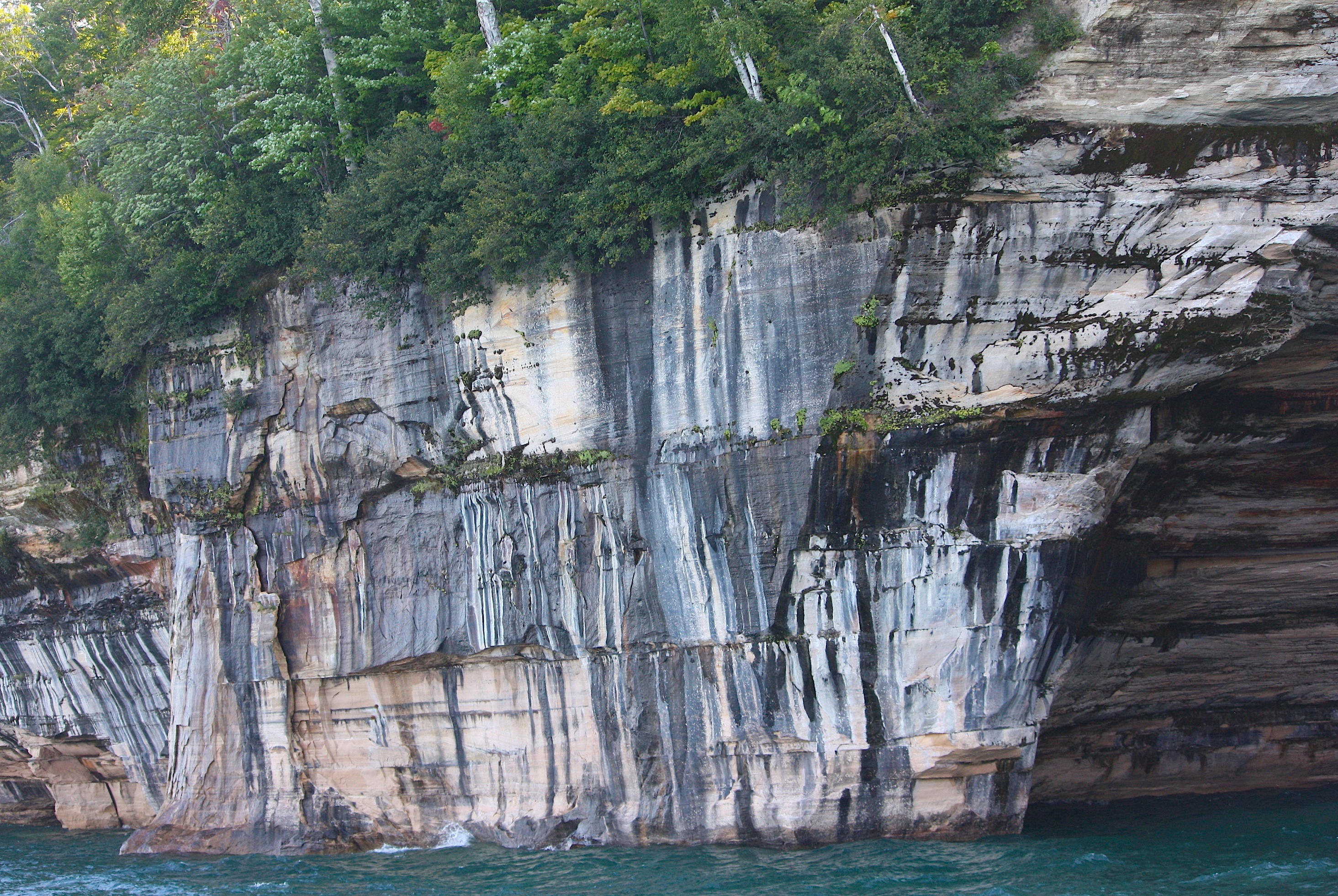
Pictured Rocks was our favorite place on the trip. It’s so much more than its famous sandstone cliffs – it also has waterfalls, forests, hiking trails, and lighthouses.
We started our tour with the first Pictured Rocks cruise of the day. The tour company (authorized by the National Park Service) runs a number of boat tours of varying lengths each day. Ours left the dock at 10 a.m. and took 2 hours and 40 minutes. We were at the front of the line so we could grab a good seat on the right side of the boat’s upper deck.
I highly, highly recommend doing this or a similar boat tour. Ours cost $36 per person. It’s the best way to see the colored cliffs, sea caves, rock formations, lighthouses, and arches. I thought it was absolutely unique and beautiful.

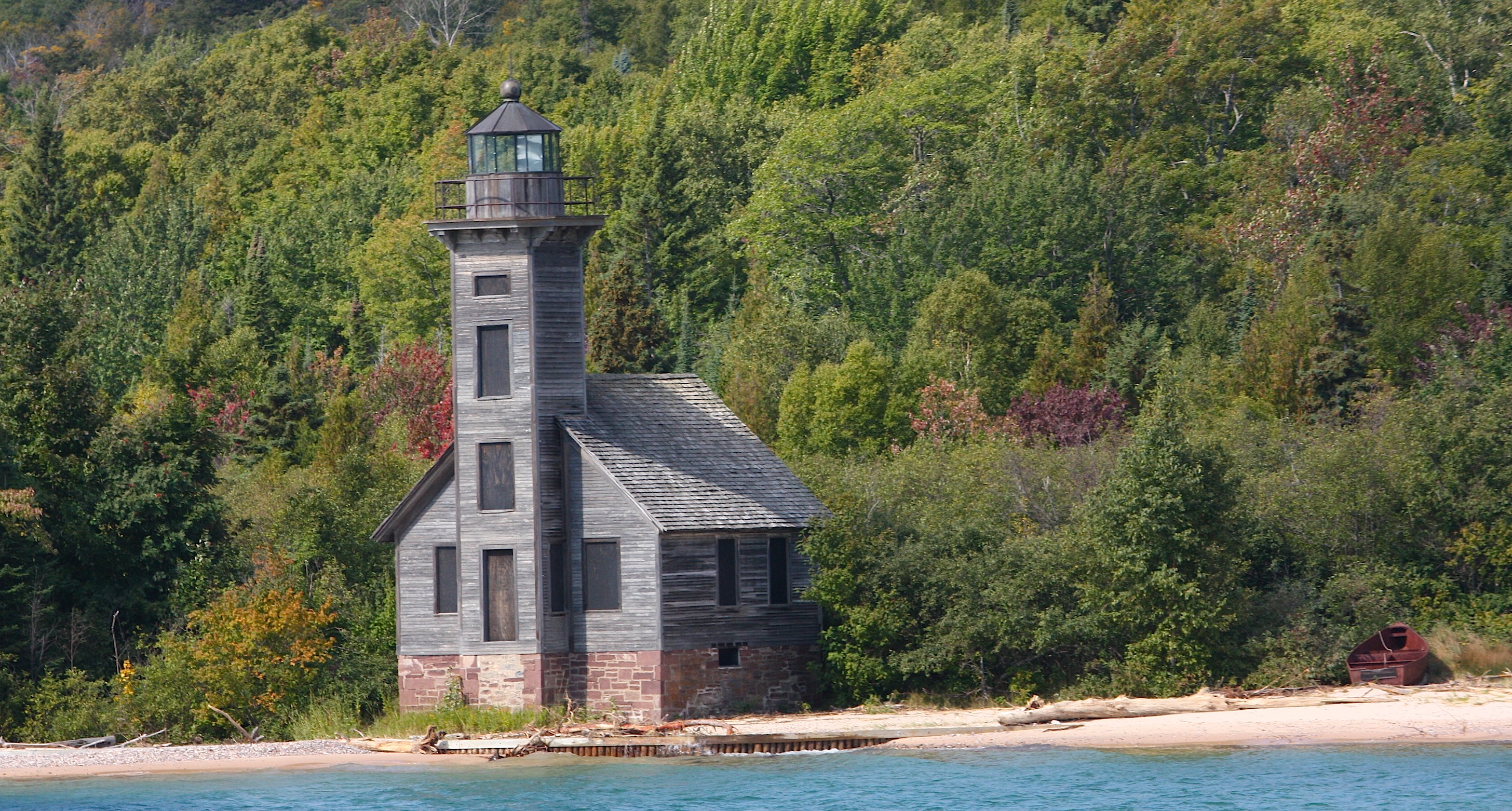
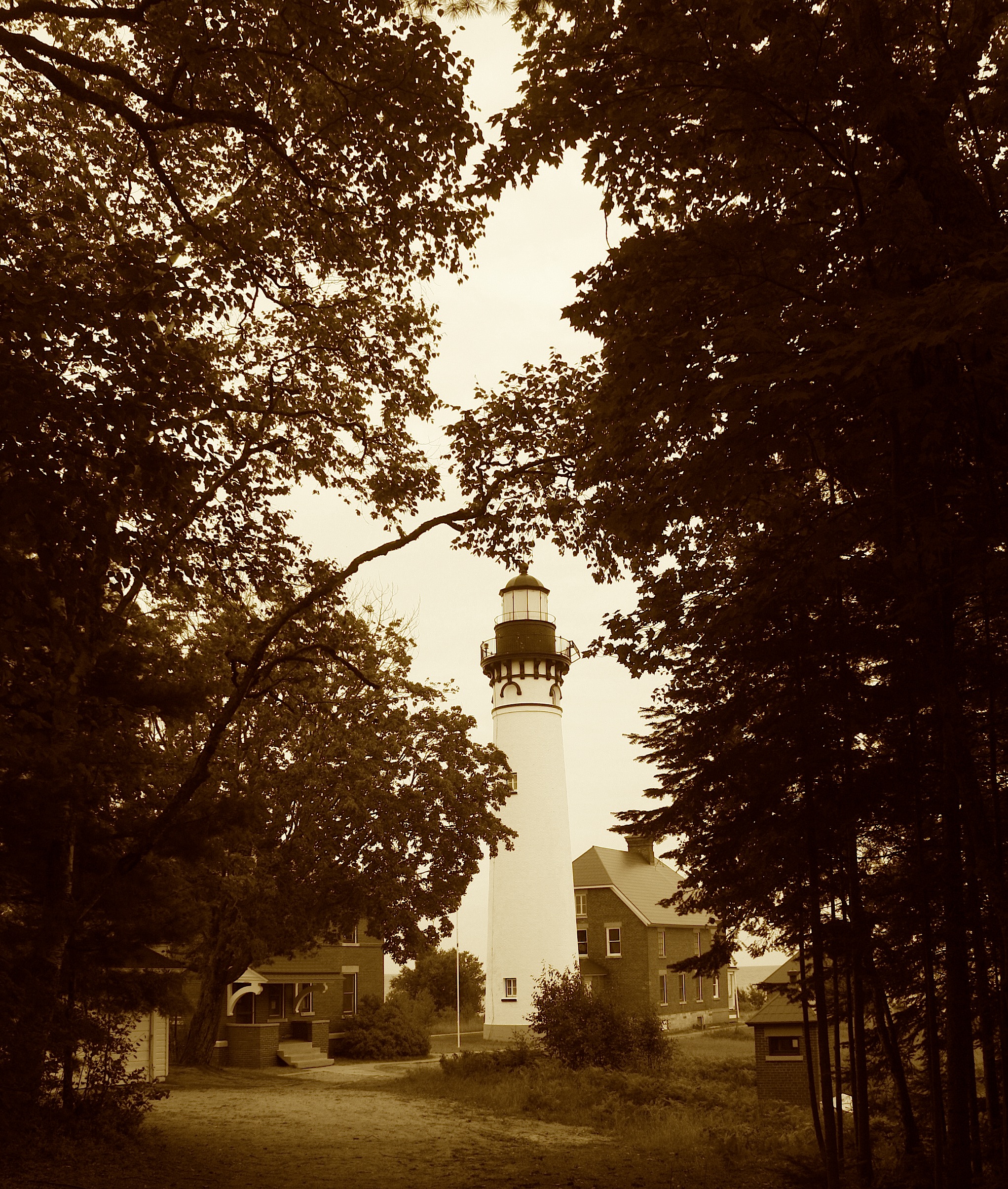
I sat through pretty much the whole thing but still managed to work up an appetite. We ate lunch at the Navigator restaurant in Munising, right across from the cruise headquarters. And then we spent the rest of the day hitting the highlights of the national lakeshore: Munising Falls (a quick boardwalk stroll from the parking lot), Miners Castle (an awesome overlook), Au Sable Light Station (a 1.5 mile walk to the prettiest lighthouse we saw on the whole trip), Log Slide overlook (a scenic view with interesting logging history), and Sable Falls (lots of steps with a waterfall and lake walk payoff). Here’s a whole photo gallery:


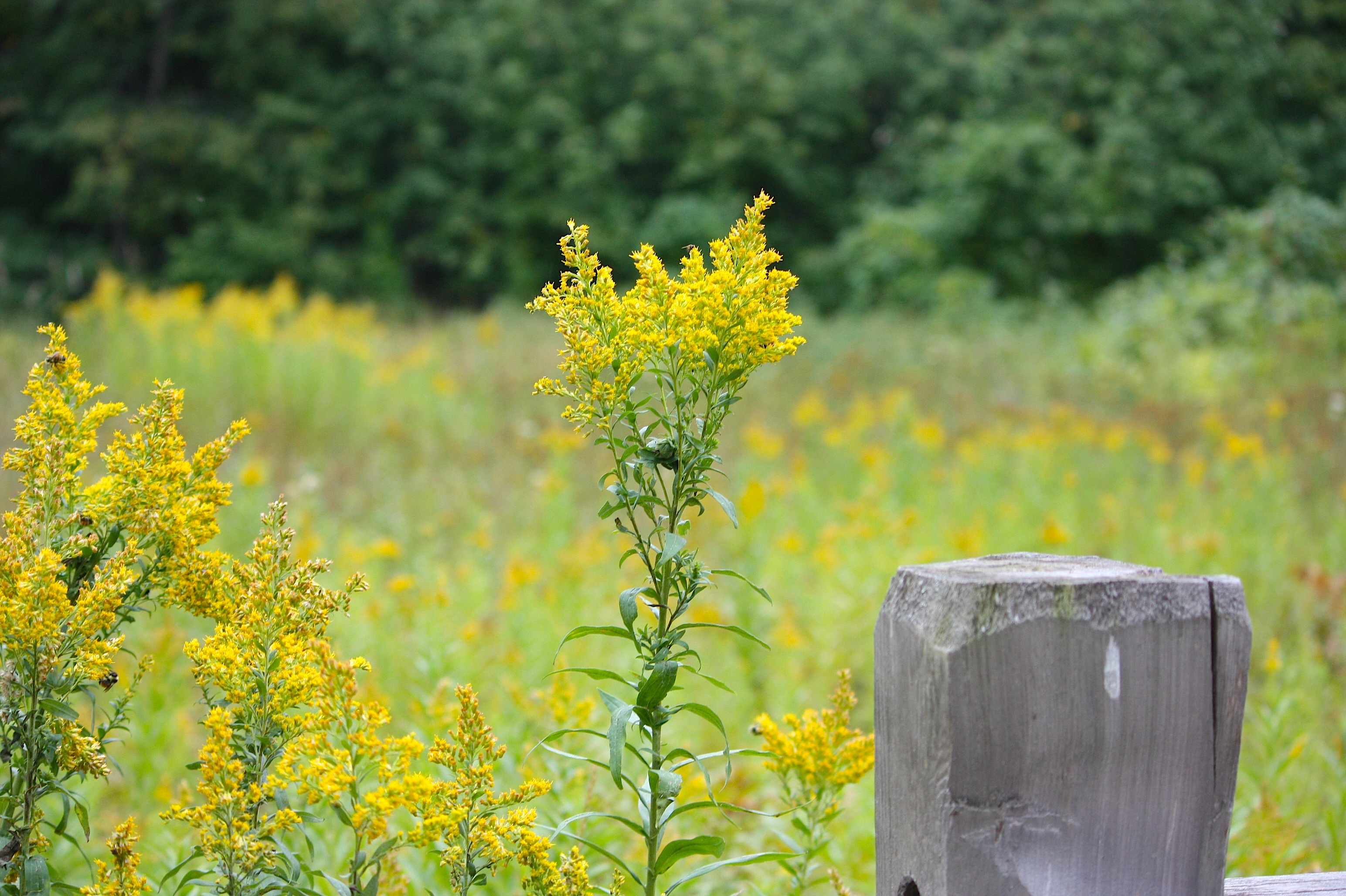
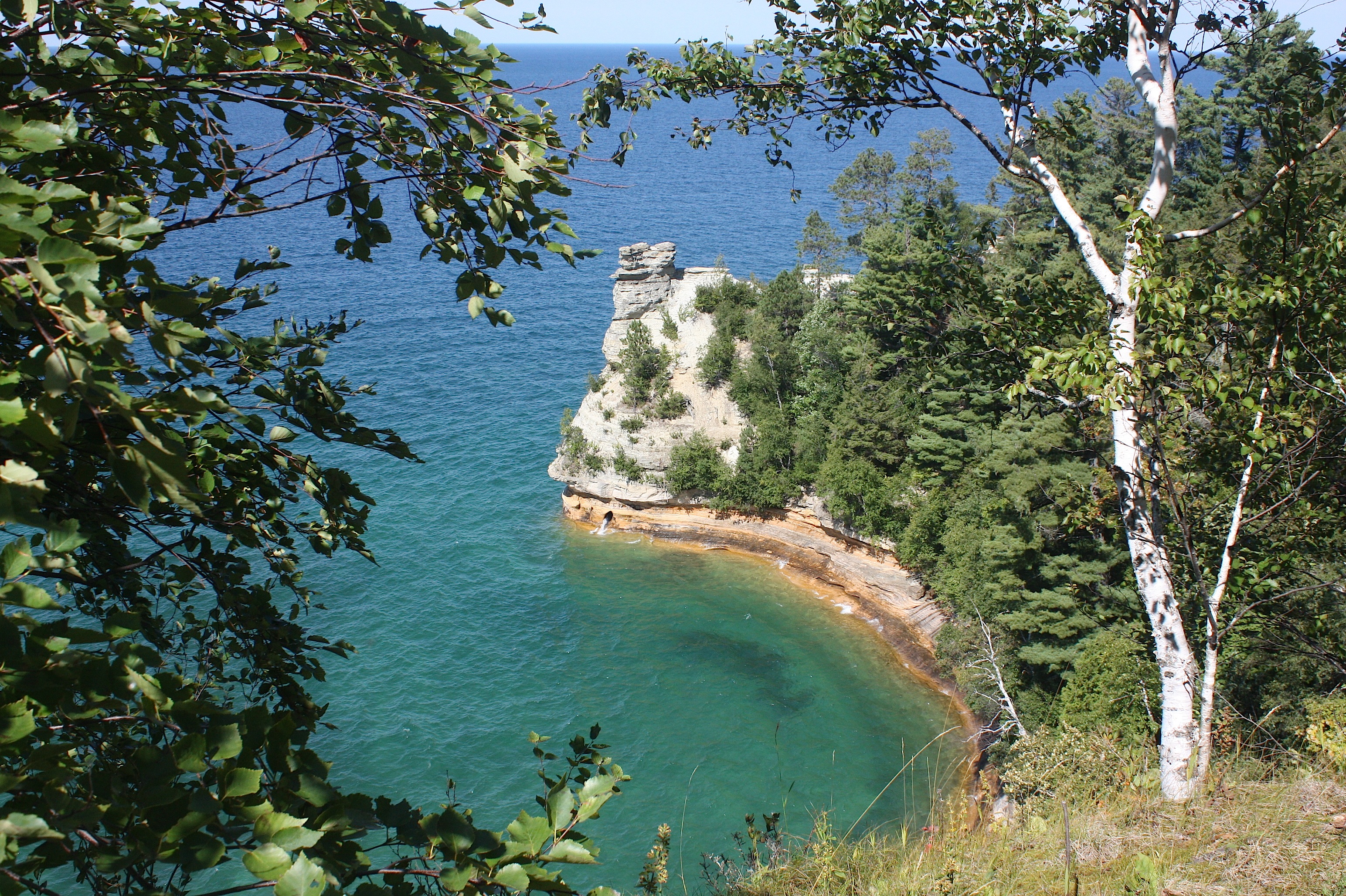
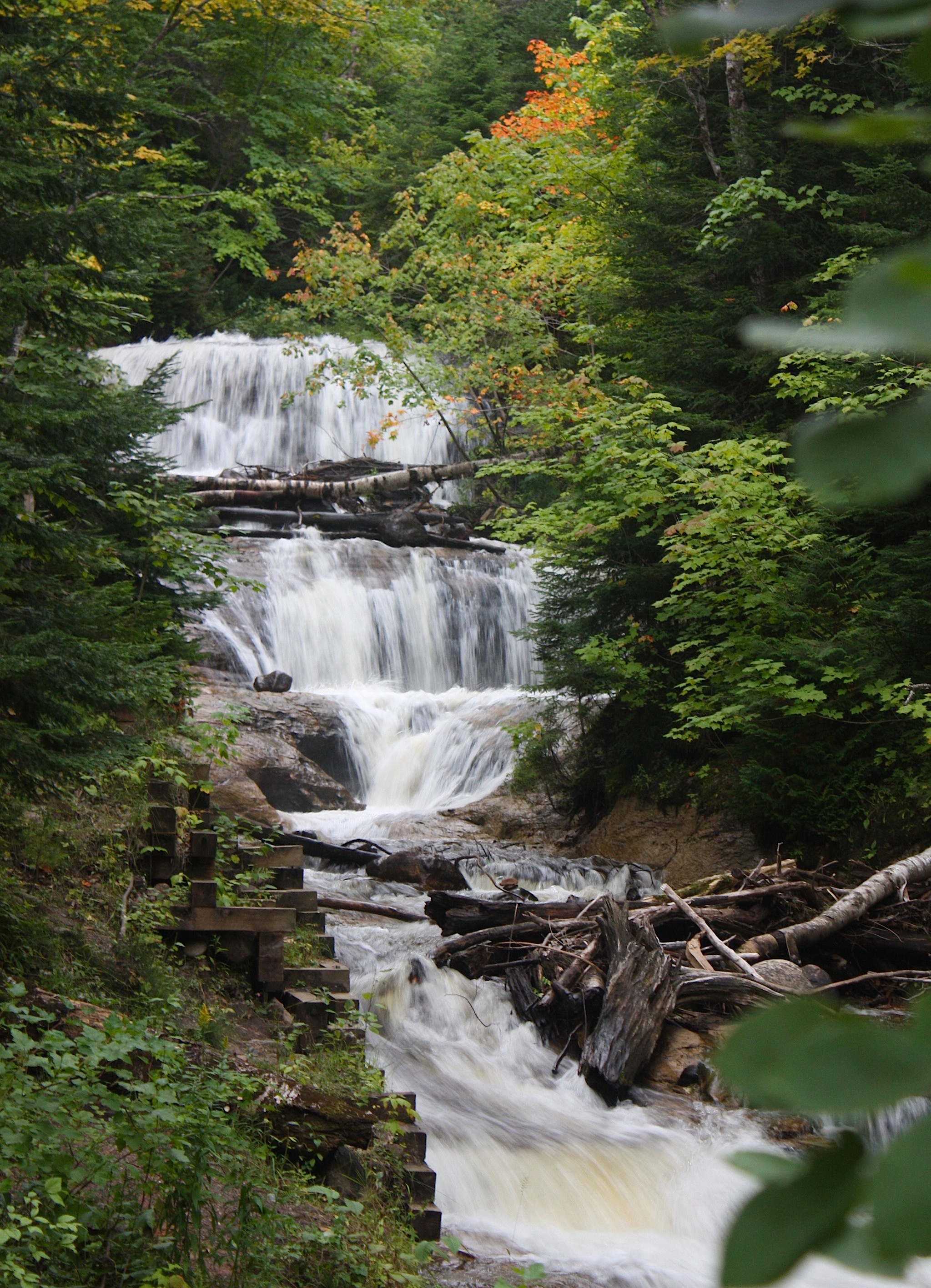


It was a lovely place. In my younger days I could have spent three days here, hiking the trails and exploring the entire park. But today I was satisfied with the amount of walking I did and all the great scenery. The national lakeshore ends at the town of Grand Marais; from there, we drove south and then east to Newberry, the only town of any size in this part of the UP and our home for the night.
TAHQUAMEMON FALLS STATE PARK
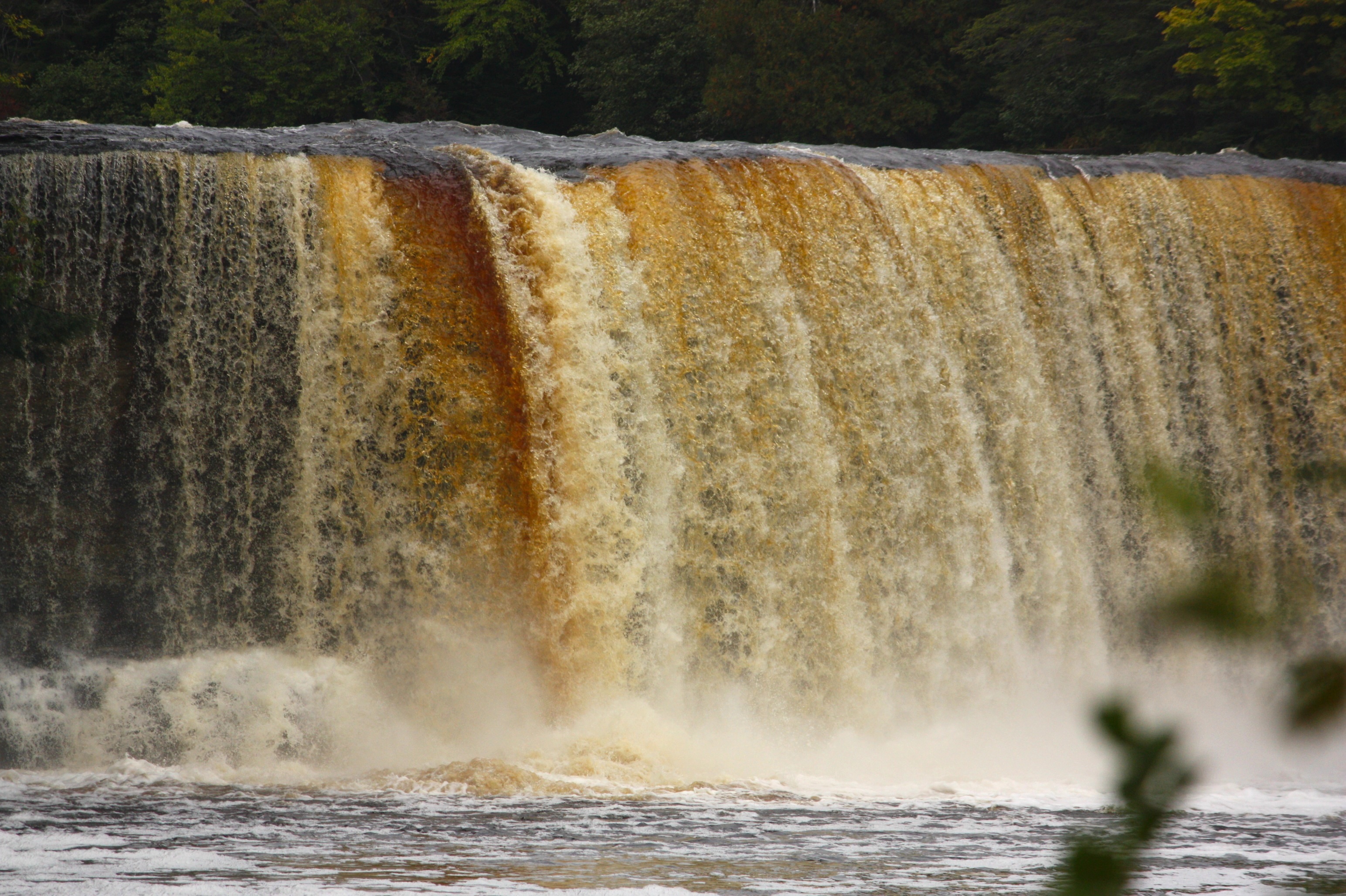
This morning, after a breakfast of blueberry pancakes at Pickleman’s restaurant in Newberry, we drove the 26 miles northeast to Tahquamenon Falls State Park. I’ve seen lots of pictures of UP waterfalls, and this might be the most spectacular falls in all of the Upper Peninsula. The upper falls are 200 feet wide and 50 feet tall. You can view them from the top or bottom, both accessible by a hundred or more man-made steps – well worth the climb.
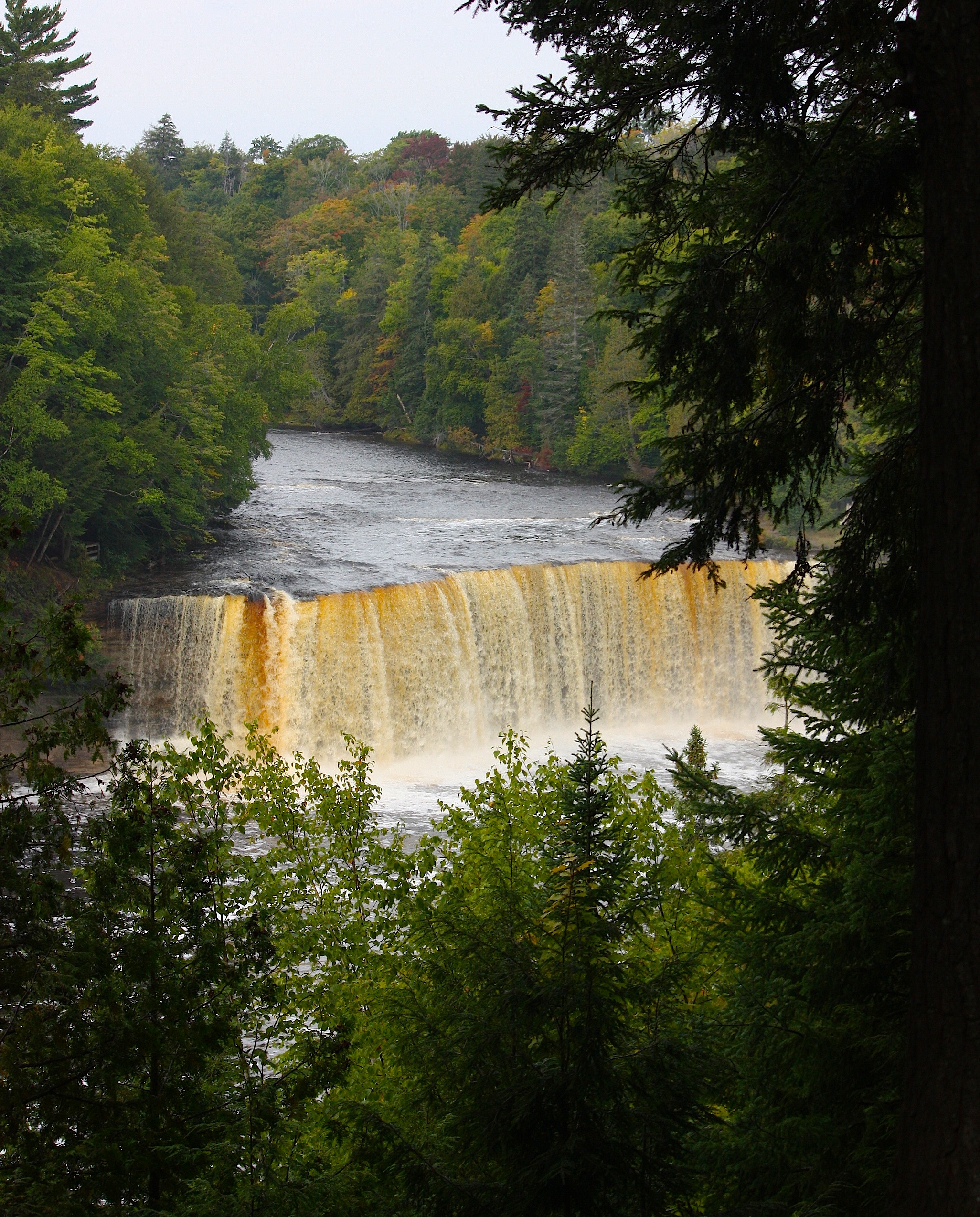

The lower falls of the Tahquamenon River are less spectacular in terms of sheer size, but I think they’re more beautiful because of their setting (above). They are easily viewed by walking along paved and boarded walkways. When we were there, the trees were turning and the whole thing was just glorious. The entire park is 50,000 acres, with tons of hiking trails, camping, fishing, boating, and cross-country skiing.
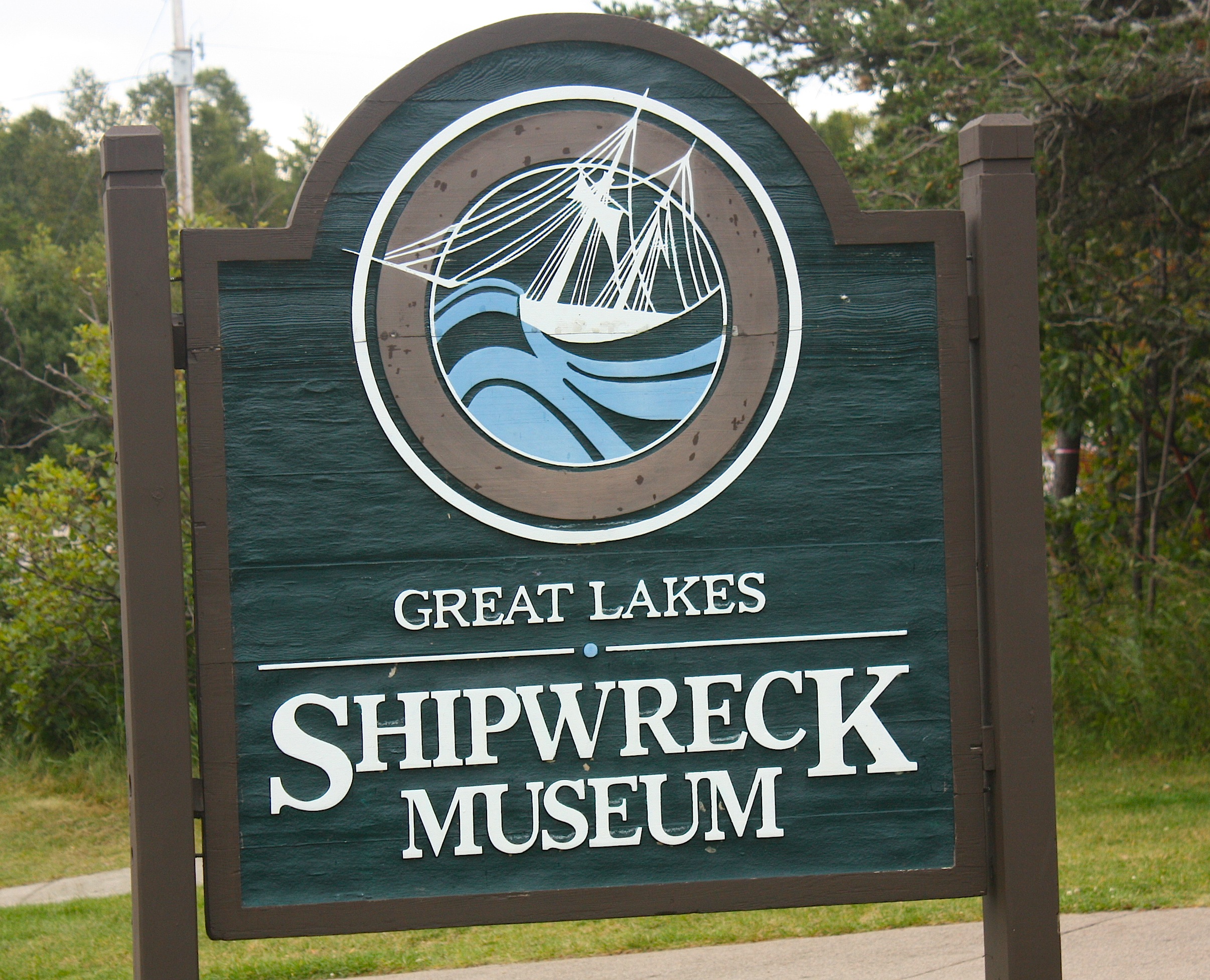 Like most things in the UP, Tahquamenon Falls State Park is pretty much in the middle of nowhere. But if you continue a bit east to the town of Paradise (it’s definitely not), turn north, and drive until the road literally ends on a tiny spit of land sticking out into Lake Superior, you’ll find the Great Lakes Shipwreck Museum.

Thanks to the Gordon Lightfoot song, pretty much everyone knows about the wreck of the Edmond Fitzgerald, which happened just 17 miles off Whitefish Point, the location of the museum. For a $13 entrance fee you can learn more about the Fitzgerald and other Lake Superior shipwrecks. There are lots of them, it turns out. Besides the main museum, you can also tour the Whitefish Point Light Station (above) and the Shipwreck Coast Lifeboat Station. Normally there’s a movie as part of the entrance fee, but the theater was undergoing restoration so we got a DVD to watch at home.
MACKINAC ISLAND
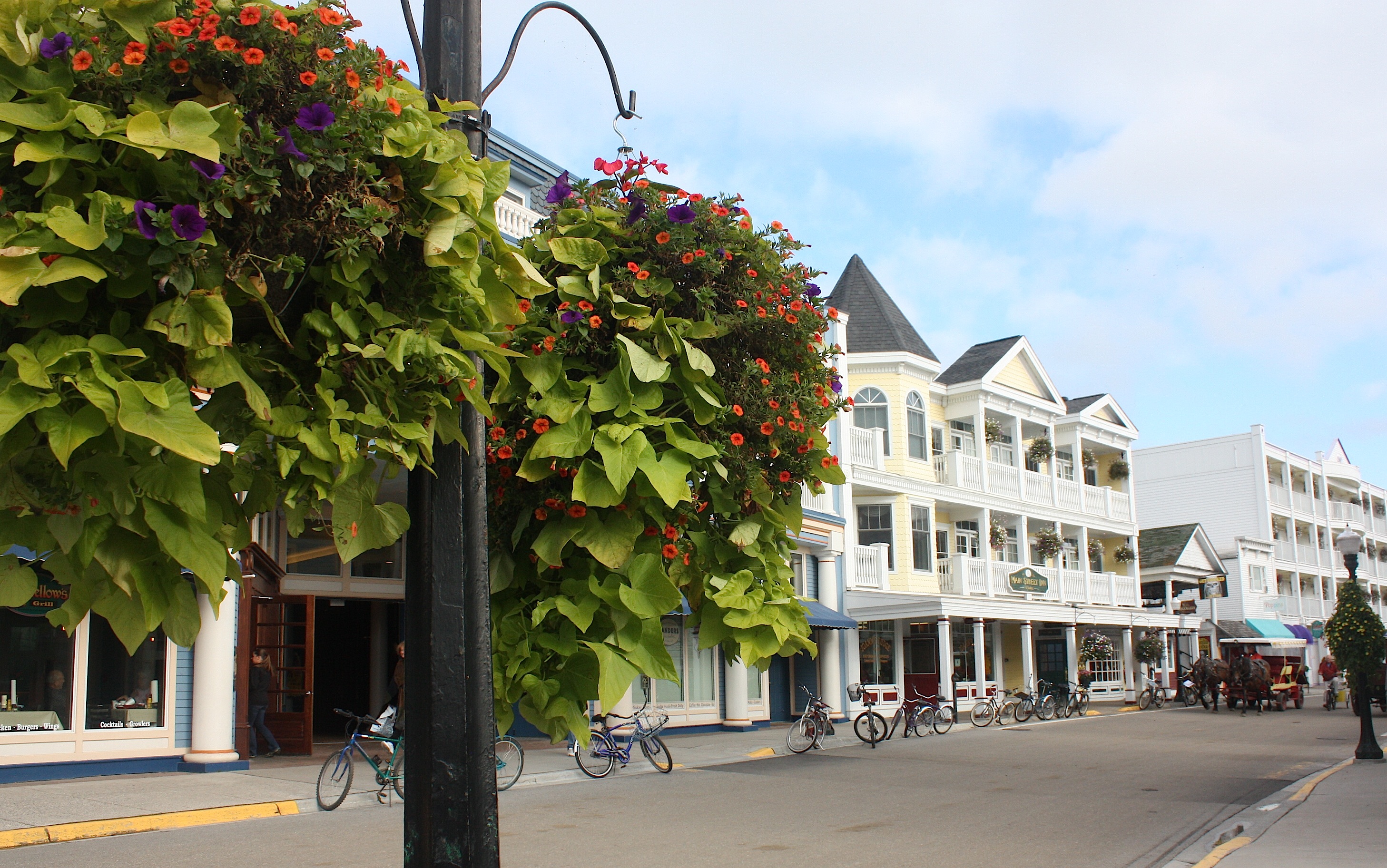
From Whitefish Point, we drove south on Hwy. 123 (a remote two-lane with lots of fall color) to the town of St. Ignace, our home for the next two nights. (We changed our itinerary midway through our trip, eliminating our drive to Sault Ste. Marie to cross into Canada – it just seemed excessive. Instead, we decided to go directly to St. Ignace (pronounced “Igniss”) so we could get an early ferry to Mackinac Island the next morning.
We stayed at the Holiday Inn Express and got upgraded to a deluxe queen room with a terrific view of Lake Huron. We would have heard gulls screaming all night if we had left the balcony door open, but we didn’t because it was too cold.
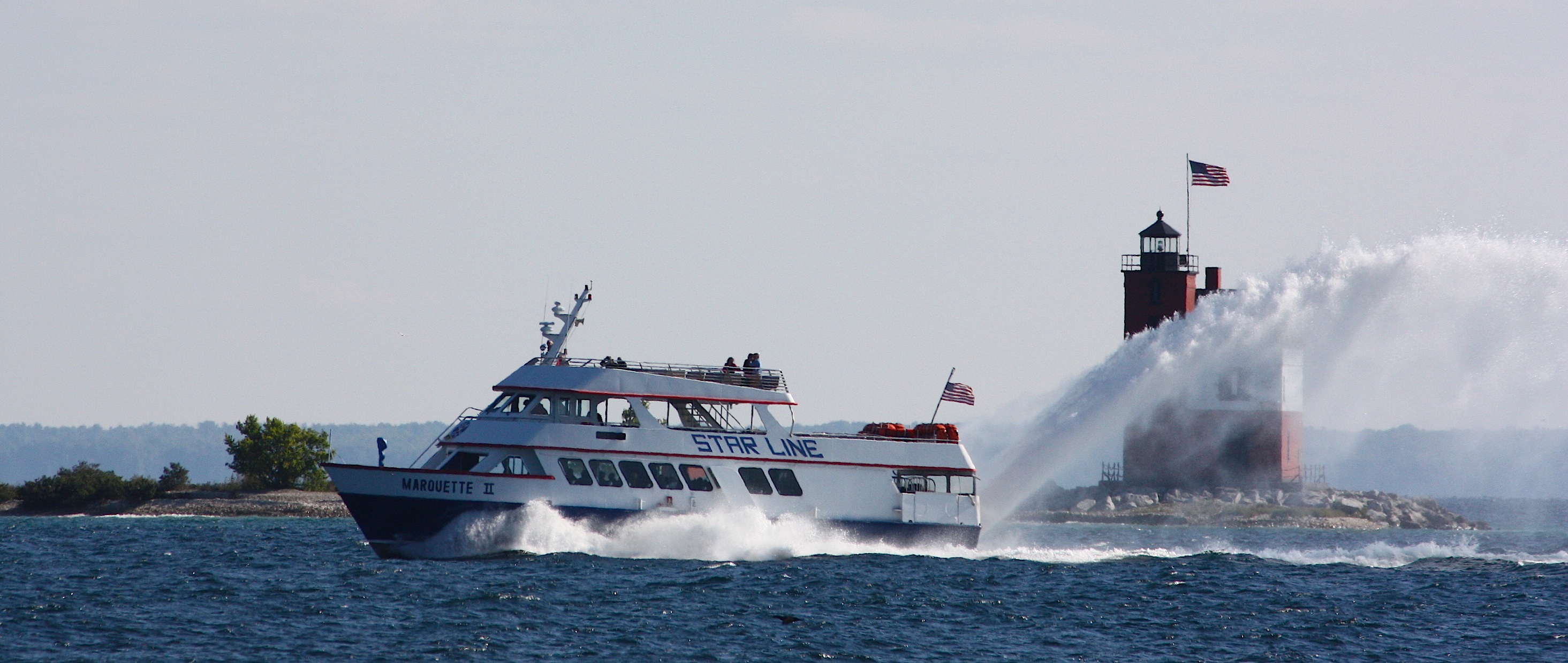
To get to the island, you have to board a ferry either at the north end of the Mackinac Bridge (in St. Ignace) or the south end of the bridge (in Mackinac City). There are several ferry providers; we took a Star Line hydro-jet ferry from St. Ignace. It was quick and efficient. About half of the passengers on our 9 a.m. boat appeared to be locals using the ferry as commuter transportation. Nearly everyone, including us, rode inside the ferry and not on the observation deck. I’m guessing it was pretty wet up there, not to mention cold, because the morning temperature was in the low 40s. As the ferry rounded the south end of the island toward the dock, we got a great view of the Grand Hotel and the elegant west bluff cottages.
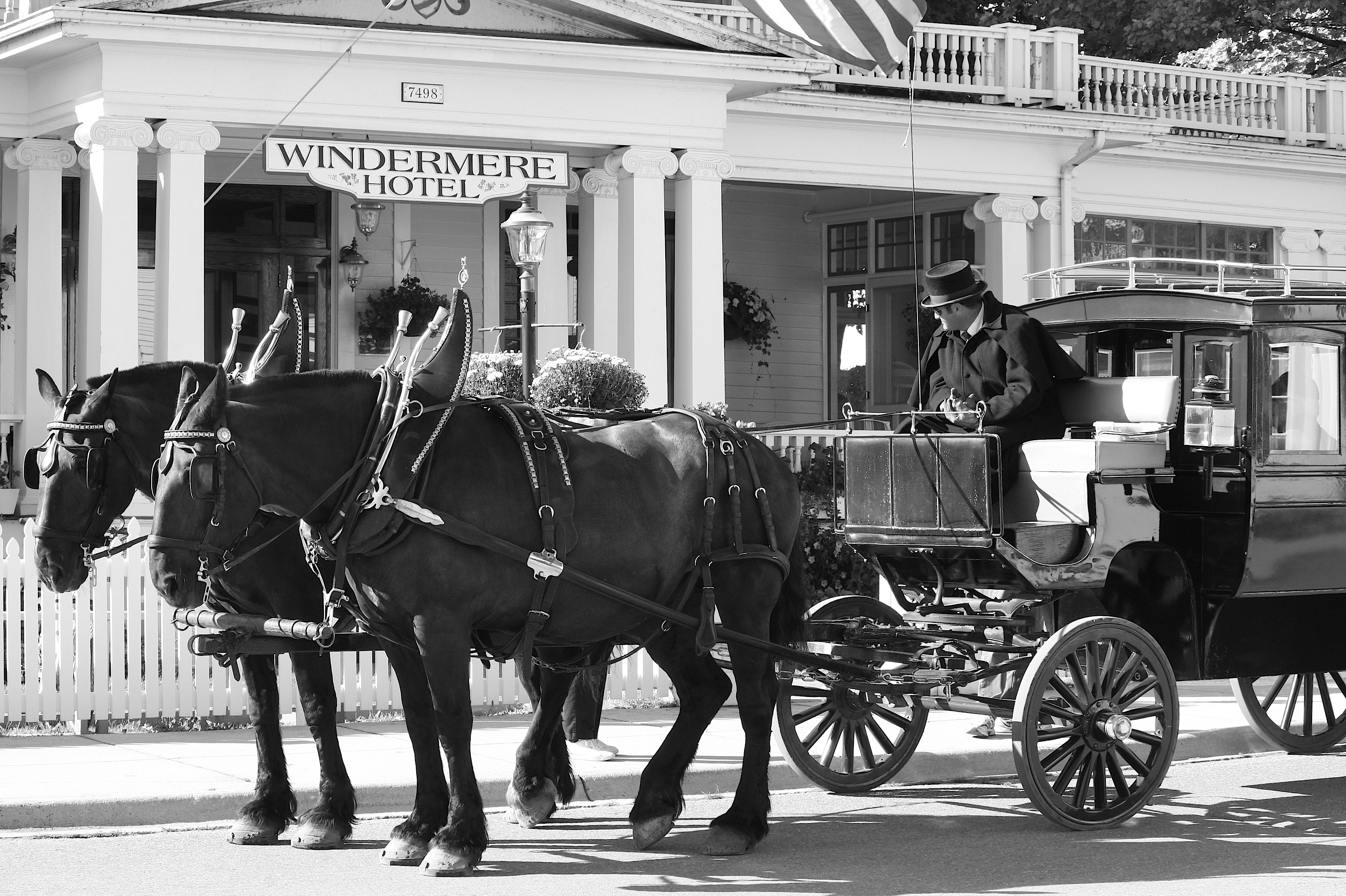
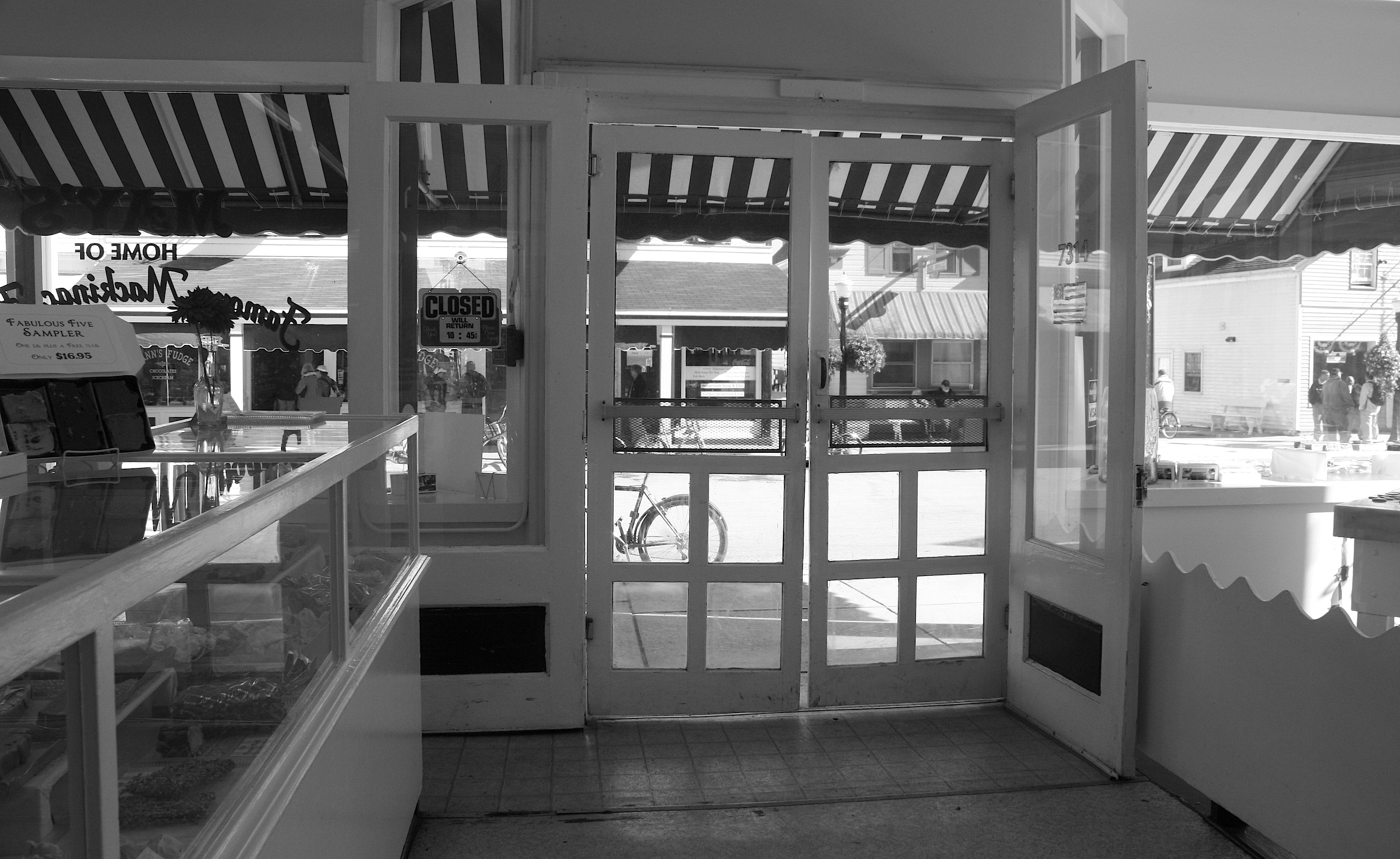
Once off the ferry, I was told to expect to be hit with two odors: fudge and horse poop. Sort of a chocolate-poop smell. I can’t say that I found either odor overpowering, although at different points in the day I did smell horse manure. I’m guessing it’s worse in the summer, both because of the heat and the increased number of tourists.

Dave and I walked to the right, down the main street and around the southeast end of the island to Arch Rock. It’s a pretty walk along Lake Shore Blvd., and the natural arch is moderately interesting (though after Pictured Rocks, stuff like this sort of pales in comparison). After that walk I was cold, my feet hurt, and I was very eager to find a good cup of coffee. I didn’t. I ended up ordering a latte at one of the many, many fudge shops, and it was lacking in every way.
We were hungry by this point, anyway. So we walked around a bit and then found lunch at the Village Inn. From there, we walked to the Grand Hotel. Of course, you can’t walk INSIDE the Grand Hotel – or even on the sidewalk in FRONT of the Grand Hotel – without paying a $10-per-person fee. I will say that although I totally get the reason for this, it still sort of pisses me off. We walked as far as we could until we were turned away by the young, female hotel bouncer, then briefly toured the hotel’s gardens (she said that was OK) and ended up with plenty of good-enough views of the place.


The Grand Hotel opened in 1887; it’s ridiculously famous and is said to have the world’s longest front porch (660 feet long). If you stay there, expect a lot of amenities, but expect to pay a hefty price for them: the smallest rooms start at $275 per person for a double (that’s $550 for the two of you) during the week; the price goes up on the weekend and for larger rooms, topping out at $410 per person ($820 for a double room). To be fair, the room does come with meals, but who needs THAT much food?
We did not stay the night on the island, but if we were going to, we’d stay at one of the many, many other inns and B&Bs that look very nice for far less cash.
Here’s a bit of history of the island: It’s been a favorite destination since it became Mackinac National Park in 1875 – the United States’ second national park after Yellowstone; it’s since been transferred to state control. The park covers about 80% of the island.
I’m sure you already know that there are no cars allowed on the island, only horse-drawn vehicles, horseback rides, and bicycles. You can pay for a horse-drawn carriage tour or taxi, and bicycles are available for rent.


We visited historic Fort Mackinac (above), a walled fort that sits high above the downtown area. It’s a $12 entrance fee, and even though I don’t get into the history all that much (British & American troops fought over Fort Mackinac during the War of 1812, yawn), I’d pay the fee again just for the view – it’s amazing (below). Dave enjoyed the fort, with its historic displays and costumed interpreters.


What else is there to do on the island? You can bike around the perimeter, explore the state park, play golf, or do what most visitors do – just hang out in the downtown area, enjoying the Victorian homes (above), the many fudge shops (the earliest of which was established in 1887), and other places to eat and drink. We had a pleasant beer at the Pink Pony bar and grill, bought some candy, and took the 5 o’clock ferry back to the mainland. Afterwards, I sort of felt like I’d spent the day at the Magic Kingdom.
SLEEPING BEAR DUNES NATIONAL LAKESHORE
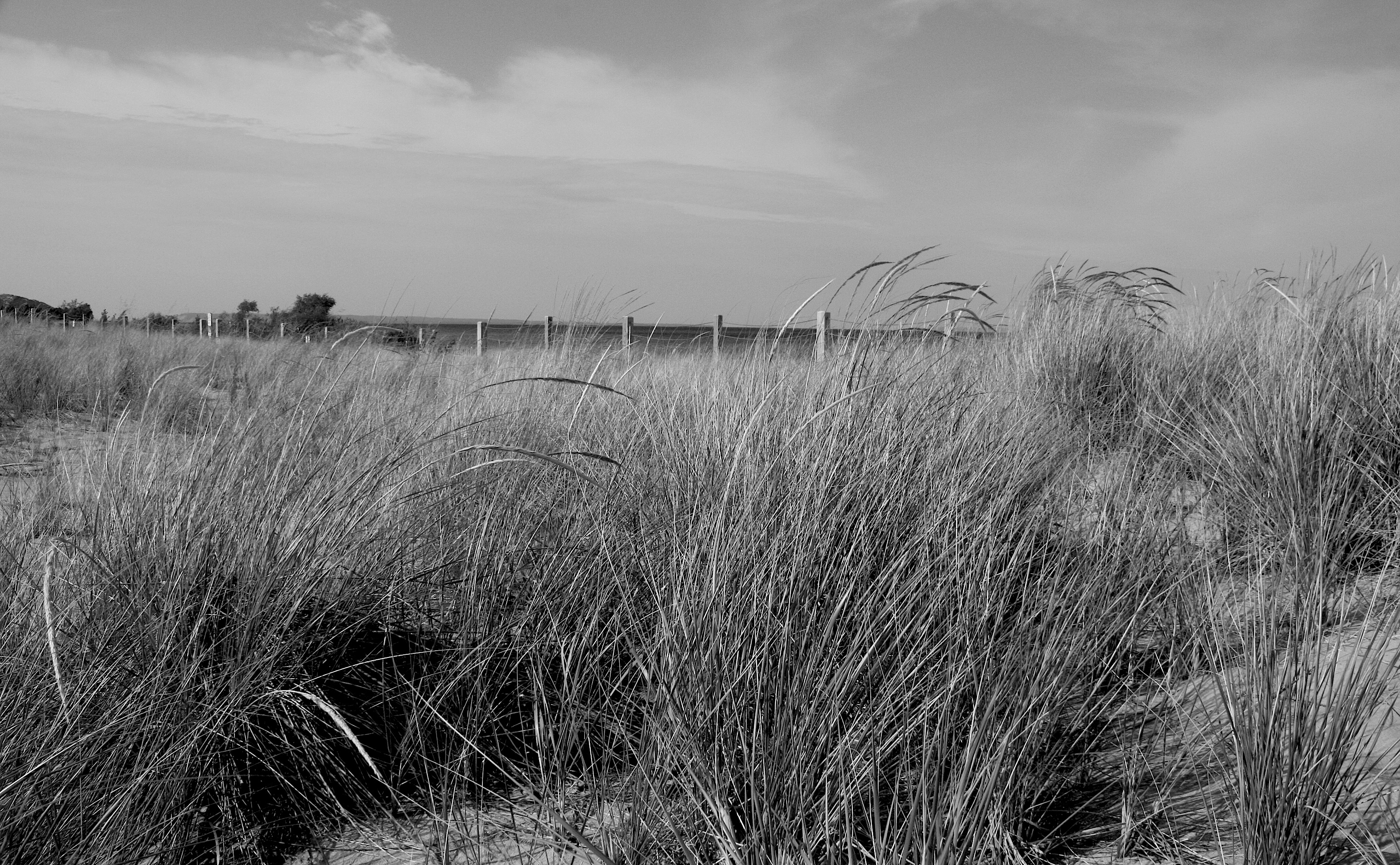
The next day we crossed the Mackinac Bridge. Constructed in 1957, this 5-mile-long suspension bridge is the only connection between Michigan’s upper and lower peninsulas. Pay $4 per car to cross the bridge; points to observe the bridge are located on both sides. The view from the south looked much better the morning we crossed (below).

Though our original plan was to stay on the Upper Peninsula the whole time (plus Mackinac), we were convinced by my Michigan colleagues to add the northwest Lower Peninsula lakeshore region of Petosky, Traverse City, the Old Mission Peninsula – and, especially, Sleeping Bear Dunes.
Another National Park property, Sleeping Bear Dunes was established in 1970. Its 35 miles of lakeshore are divided into two districts. We spent our time in the Leelanau District.

The first thing we did upon entrance to the park ($10 per car) was to take the Pierce Stocking Scenic Drive. The drive is lovely, with several overlooks and a covered bridge. I will admit I giggled a bit at the name “Pierce Stocking” – I feel sorry for any little kid with this name.
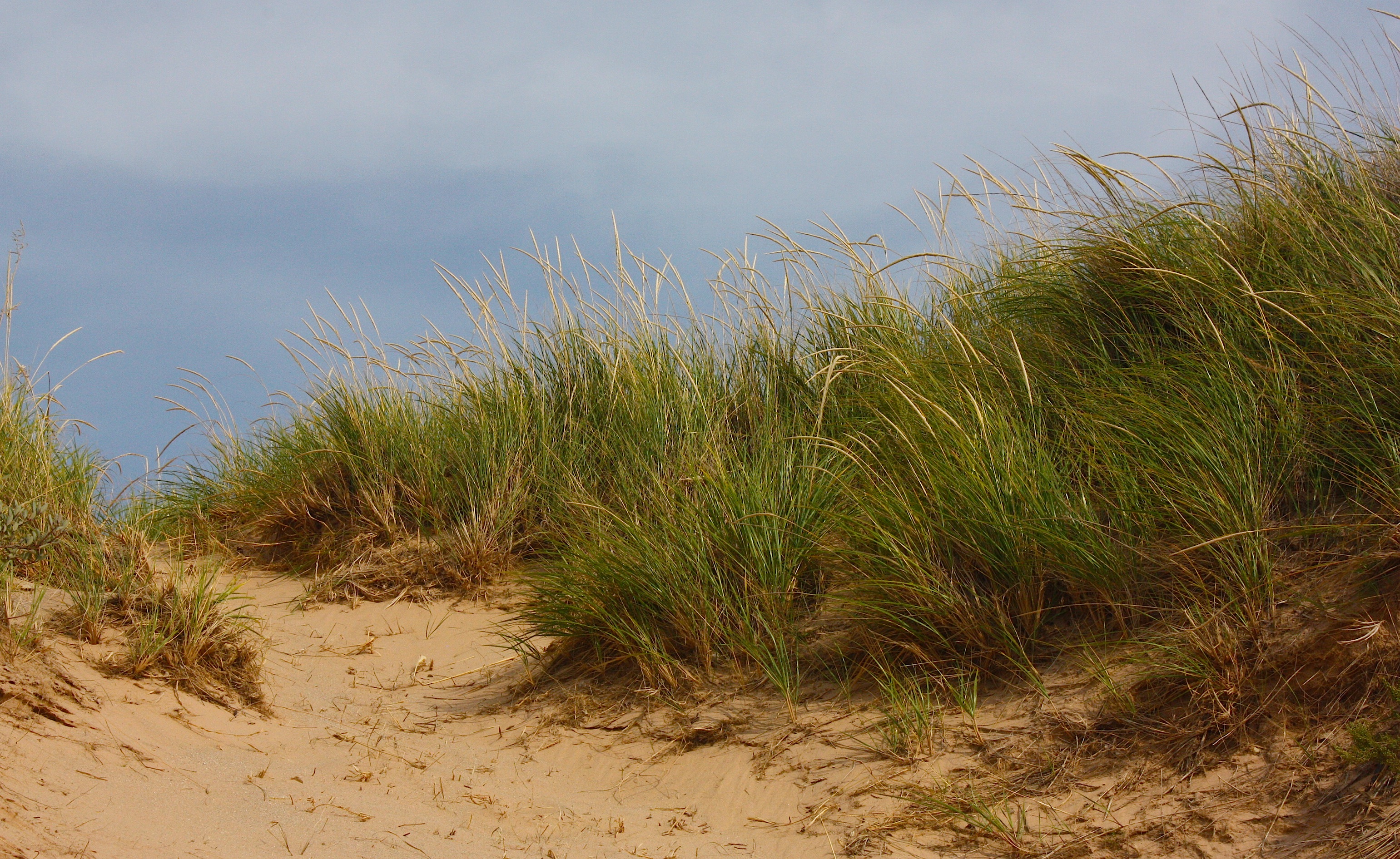

After the drive, we went to the Dune Climb (as observers, not participants) and then to Sleeping Bear Point. There’s much more to see, but we had limited time and we were told these were some of the highlights.
OLD MISSION PENINSULA

By now it was getting late and I was quite eager to get to our next stop: The Old Mission Peninsula. (It seems we were on a peninsula vacation.) I must say that this is my kind of place, and I could have spent a full day here, not just a couple of hours. The peninsula is just a skinny little spit of land poking out from Traverse City into a bay connected to Lake Michigan. Unlike the pokey parts sticking into the crashing waves of Lake Superior, this one is verdant and seems protected inside Grand Traverse Bay. It’s dotted with wineries (as is all of the area around Traverse City), vineyards, B&Bs, antiques shops, farm stands, and orchards. It’s very agrarian, with historic barns around every turn. And there’s an adorable lighthouse at the very end.

In my limited time on the peninsula, I visited the Mission Point Lighthouse (above) and drove past the Old Mission itself and the general store. I bought some mini-pumpkins and took pictures of a few vineyards. And I went to one winery: Chateau Chantal. With no time to spare (wine tastings ended at 7 p.m., and it was 6:45), we did a quick tasting ($3 for 6 tastes). The reds were acceptable, but I can buy better pinot noir for $10 a bottle at the grocery store. I really did like the whites, though, so I bought two bottles (a pinot grigio and a chardonnay, both proprietor’s reserve wines). And then Dave and I each got a full glass of white wine, plus a cheese plate, and headed out to the patio overlooking the end of the peninsula.

And then the sun went down. It was really quite lovely and a perfect way to end our Michigan vacation.
Museum of Danish America in Elk Horn

Elk Horn is a cute little town in western Iowa, just north of I-80. It’s the one that advertises its Danish windmill like crazy all along the interstate.
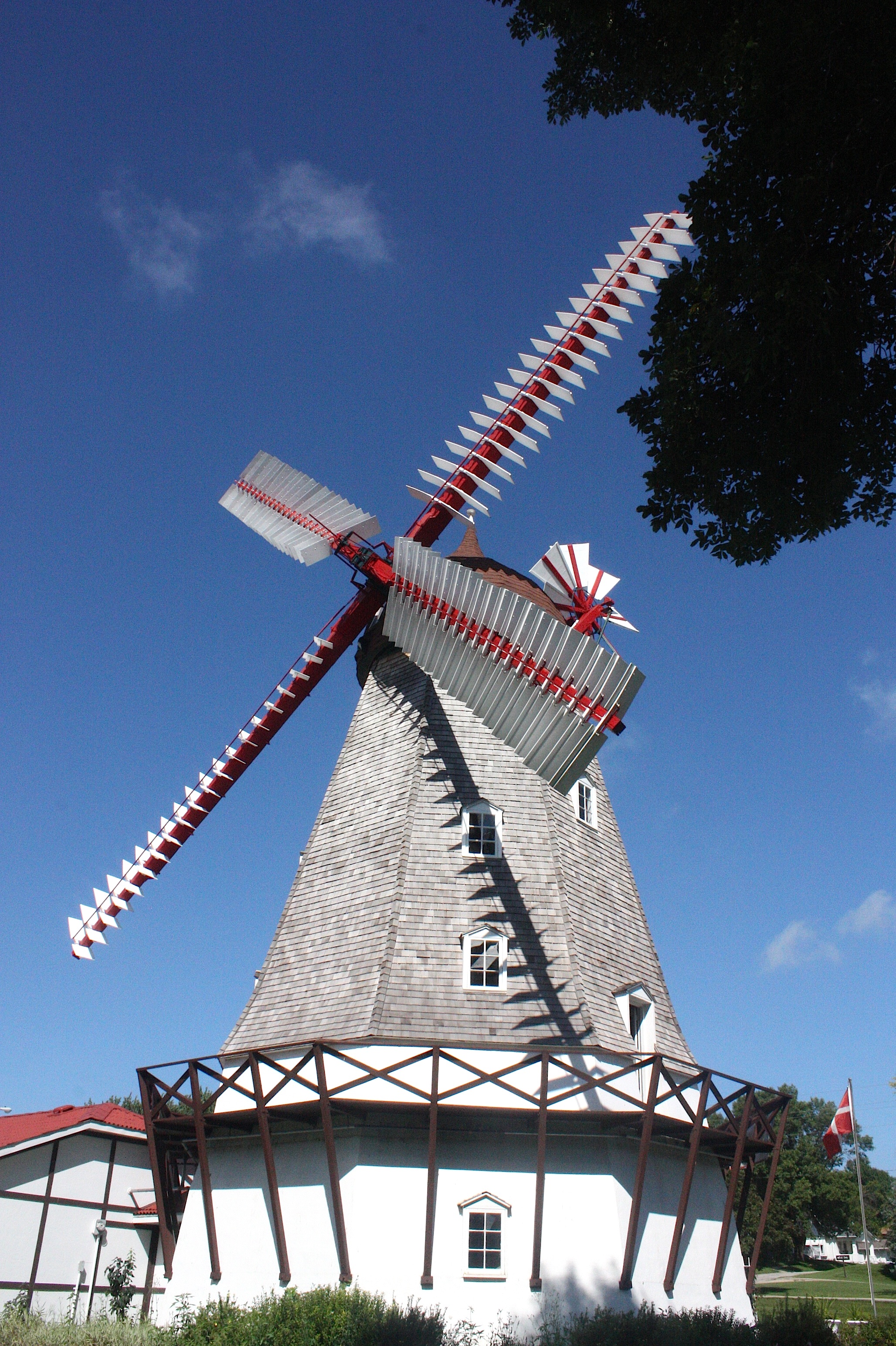 The Danish windmill is nice – there’s a museum and an Iowa visitor center inside – but there’s more to the town than the windmill.
Like Decorah with its Vesterheim Norwegian-American Museum and Cedar Rapids with its National Czech & Slovak Museum, Elk Horn is home to the Museum of Danish America.
The museum opened just west of downtown in 1994 as a national center for the Danish-American community. The facility itself is worth the visit. Its architecture, as expected, is Danish modern, with high ceilings and exposed wooden beams (below).

More than 35,000 artifacts are housed in the museum – but many are on the lower level and can’t be viewed up close. That was a frustration to me. Apparently the facility is undergoing an 8,000-square-foot expansion, so maybe these artifacts will be on display in the future. Right now you can look through glass walls just enough to glimpse some wonderful toys, dishes, and other family heirlooms and long to see more.

The immigration story “Across Oceans, Across Time” begins on the lower level and is told through display panels with words and pictures. On the main level, the story continues with more words and pictures but also a multi-media presentation and a number of objects in display cases.

Upstairs on the mezzanine level is the Kramme Gallery. When I was there, the exhibition was “Schleswig-Holstein: Turmoil on the Danish-German Border,” but the display will be changing in September.
Also on display in the main level gallery was “Nude Vases, Cubist Faces: Modernism at Rookwood Pottery.” I wasn’t expecting a quality art exhibit at this museum, so I was pleasantly surprised. The show includes pottery from the collection of Riley Humler and Annie Bauer, plus paintings by Danish-American artist Jens Jensen (1895-1978) that are reminiscent of Pablo Picasso. Both are terrific.
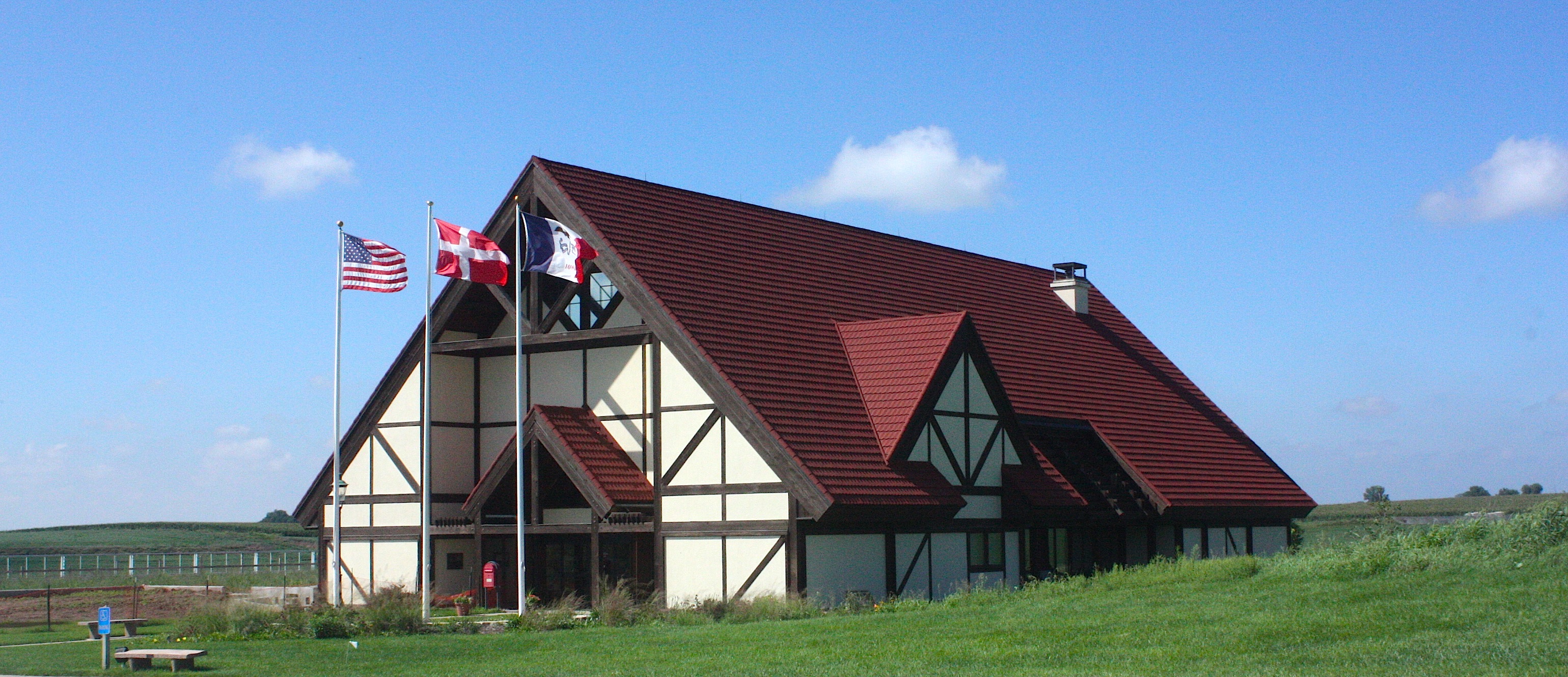
Other exhibits include the Jens Jensen Prairie Landscape Park, Jens Dixson’s House, the Bedstemor’s House, and Victor Borge’s piano, donated by Borge himself.
Kids will enjoy the LEGO area, and there’s a museum shop as well. The museum is open daily; admission charge is $5 for adults and $2 for kids.
Walnut: Antiques City
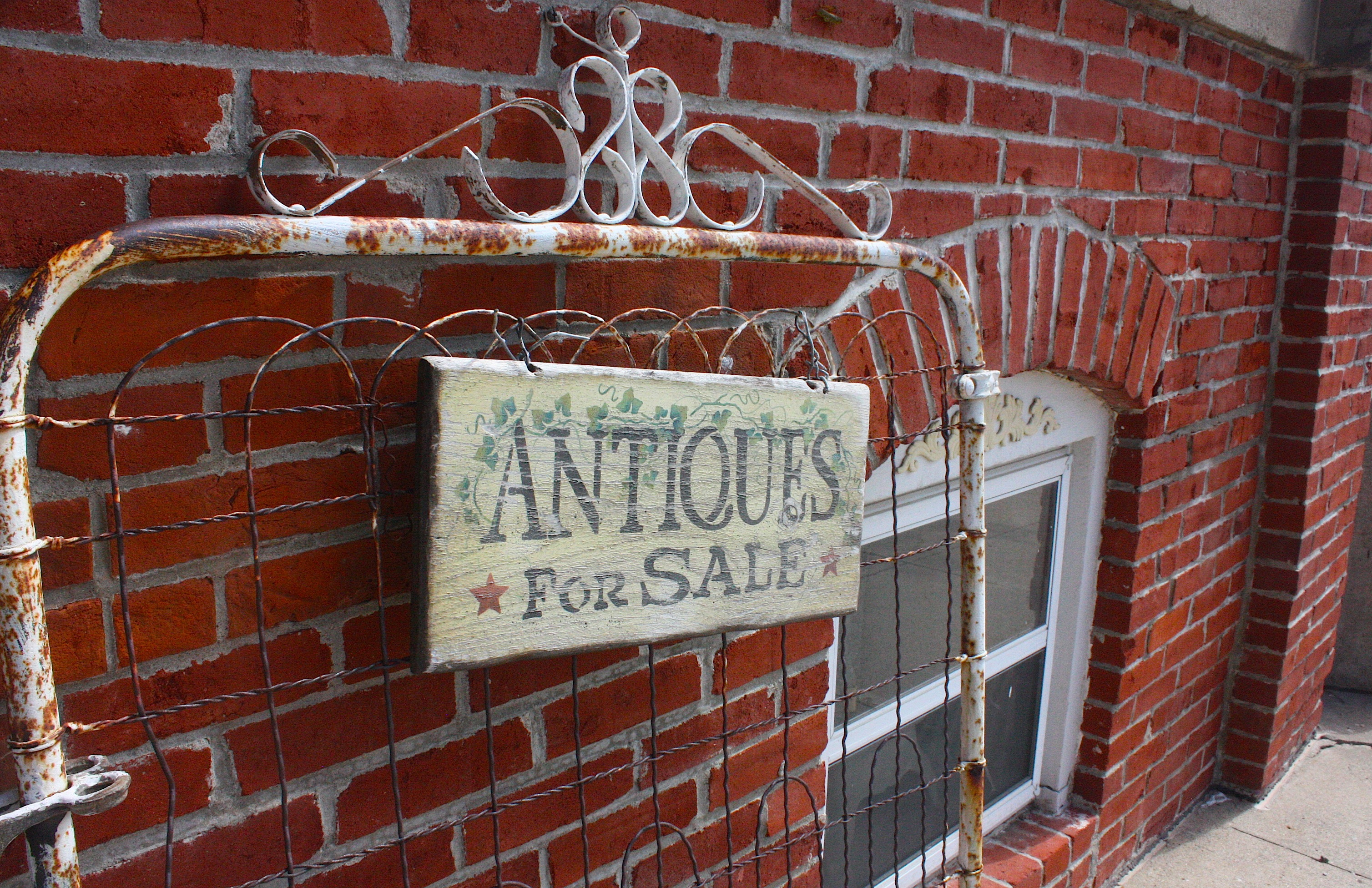
Antiques-hunting is not a dead sport! I worry about this occasionally: How do small-town antiques shops stay in business during economic downturns and, more importantly, with eBay hogging all the good stuff?
Walnut, Iowa, has figured it out. For one thing, it’s a one-stop-shopping experience for all things antique. There are about 20 stores lining Walnut’s “Antique City Drive” offering everything from furniture to vintage to junk to high-end collectibles. Plus, if you check out this website and click on “antiques shops” you’ll see a list – with links to eBay. It’s the best of both worlds.
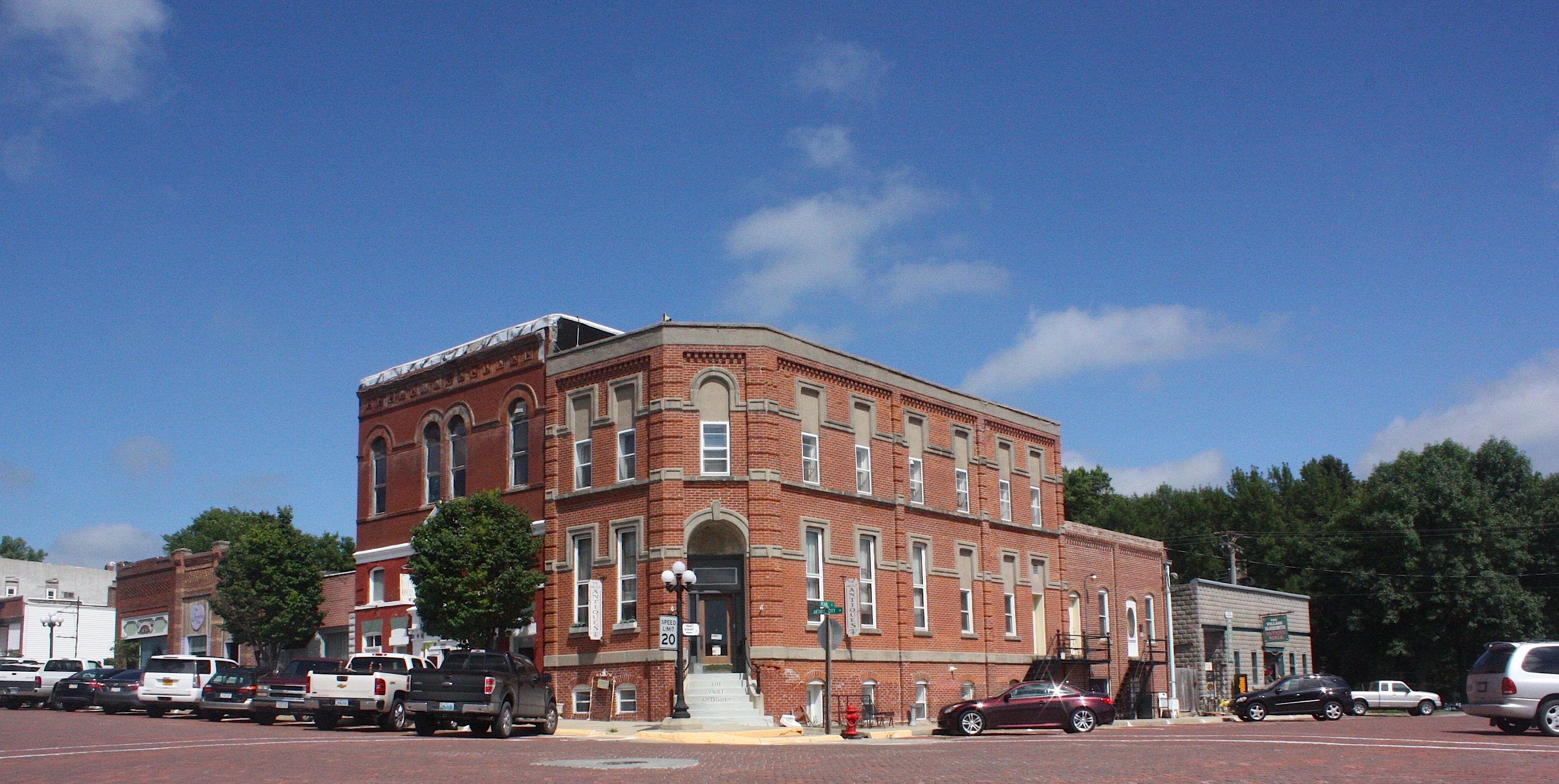
But why shop on eBay when you can walk the brick streets of Walnut, enjoy the historic architecture, poke through store after store (some of which seem to go on for miles), smell that wonderful musty fragrance, and talk to business owners and other shoppers?
I’d been to Walnut a couple of times before, and I was hoping that it was still a thriving antiques town, even with the recently tough economy. I know that I definitely don’t buy as many antiques as I used to – because, let’s face it, nobody NEEDS old stuff. We just like it.
But I spent the Saturday of Labor Day weekend in Walnut, and I was pleasantly surprised. Not only are the shops flourishing, I think there’s more of a variety.
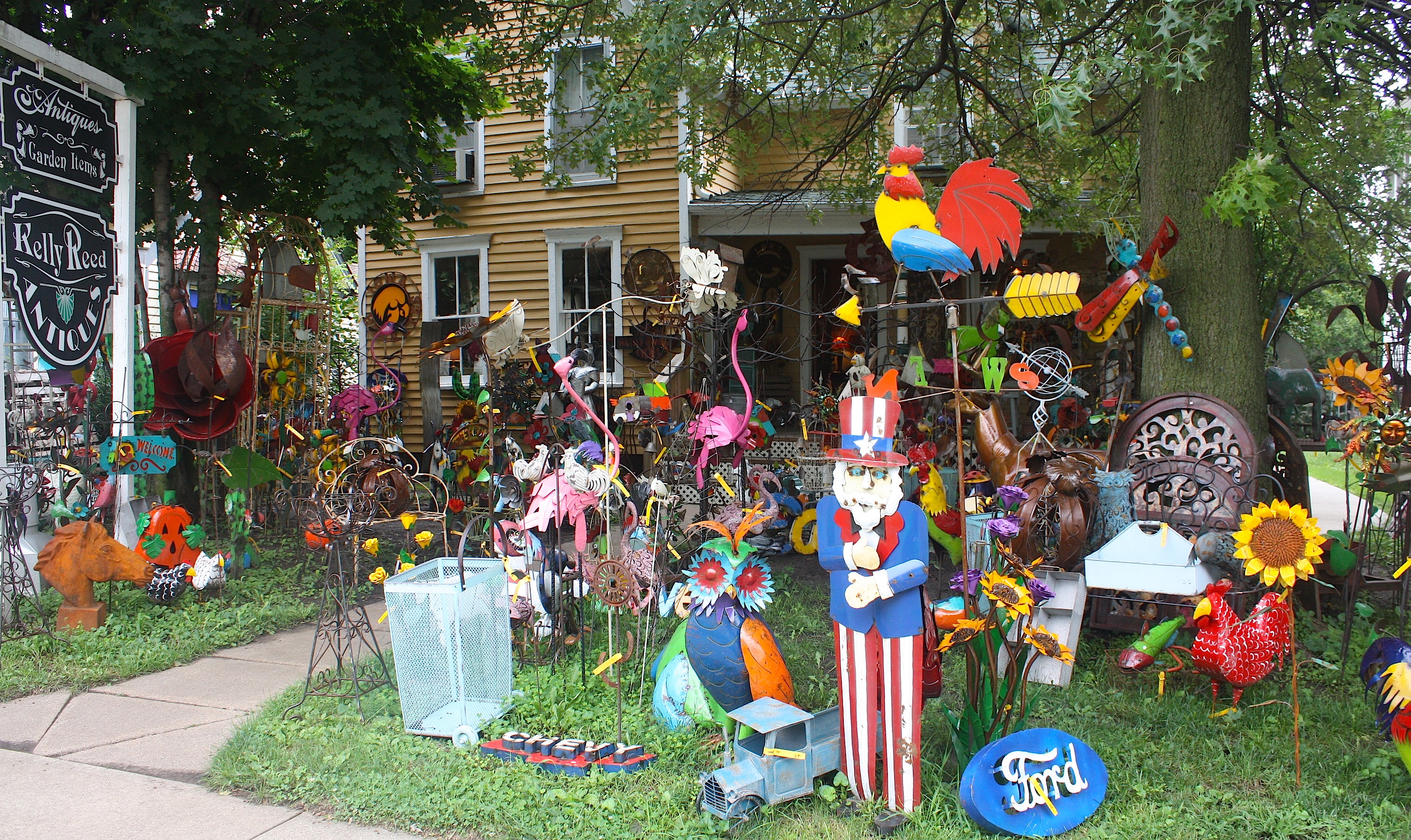
I started with Kelly Reed Antiques on the north end of downtown. I was mainly drawn to this shop by its crazy number of yard ornaments; I honestly thought the store would be sort of scary. But it was a surprisingly cool shop, if you can bring yourself to walk through all the colorful lawn chickens and such to get up to the front door. I found lots of things to enjoy here.
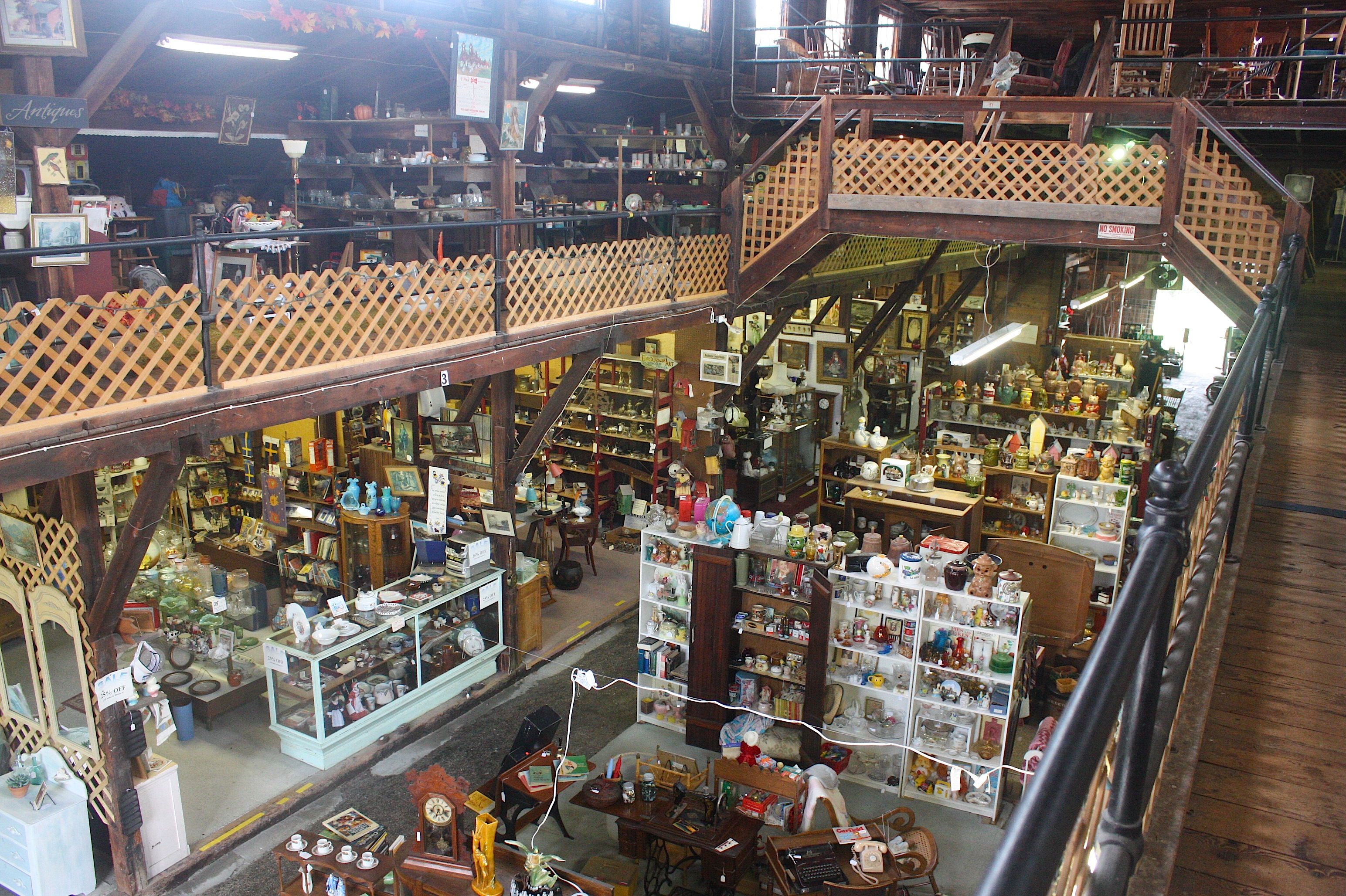
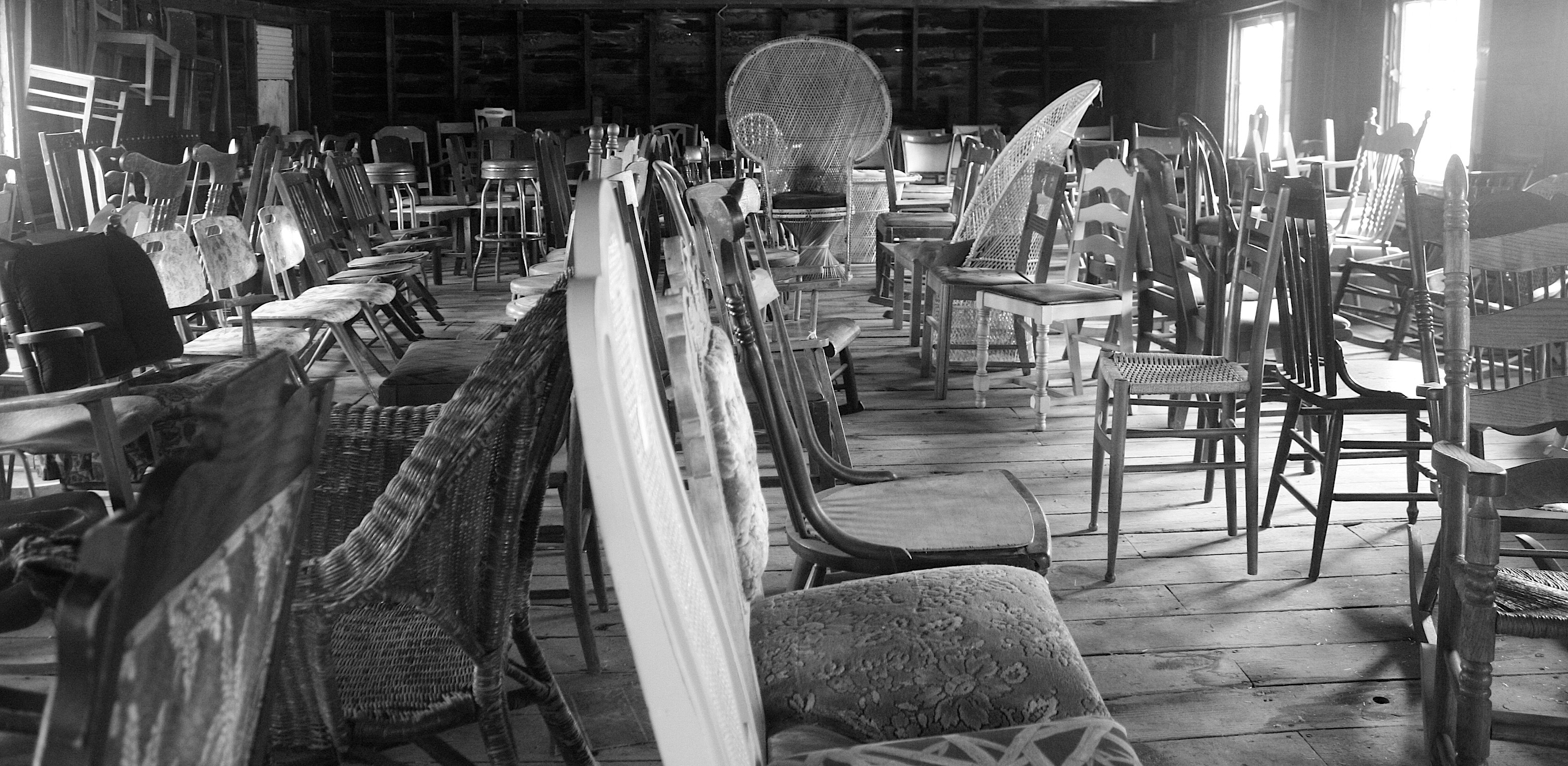
From there, I went to Bear Trap Antiques on Highland Street (just off the main street), a large store with lots of glassware and knick-knacks. Across the street is Barn Mall Antiques, an enormous place filled with booth after booth of mostly affordable used items, collectibles, and other ephemera. I recommend visiting the Barn if for no other reason than the scope. There are booths lining both sides and down the middle of the barn, plus if you walk up the stairs there are more booths lining the upper loft – including one room filled with nothing but cool, old chairs (below). The upper walkway offers an interesting overview of the whole place, because it’s all open (see above). It actually stirred up my fear of heights a bit.
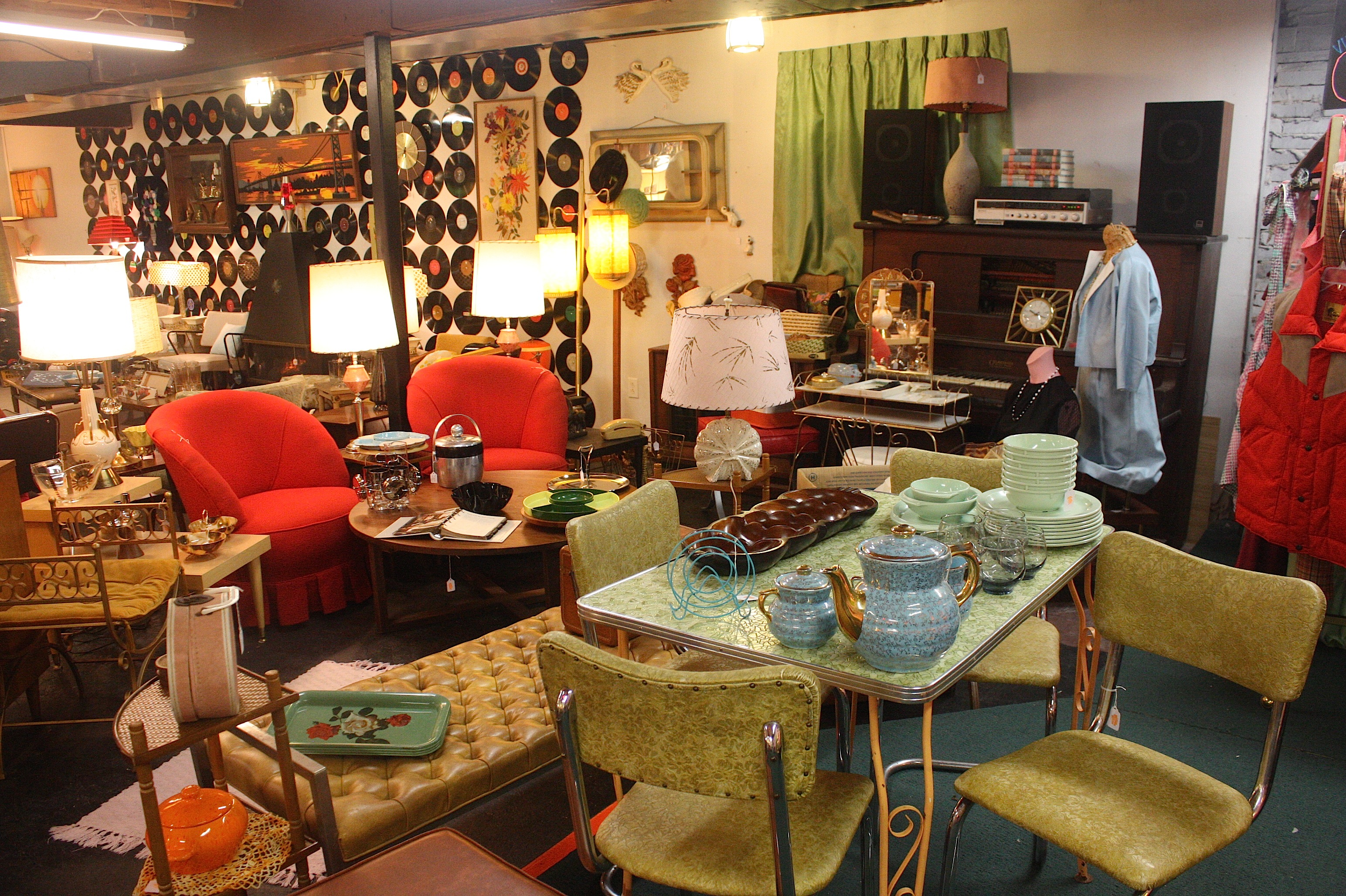
I stopped in a few more shops on the east side of Antique City Drive, but the next one that really caught my fancy was Bulldog Antiques, located in the old Opera House. This fun vintage shop would be right at home in Des Moines’ East Village or Historic Valley Junction. It’s filled with mostly mid-century furniture, clothes, collectibles, and other awesomeness (above). The owners have a very cool collection of vintage fans, classic radios, furniture from the 1940s to 1960s (you know, that era where it’s so ugly it’s cool?), records, knick-knacks, and more. I loved this store. This was the only place I actually bought something.
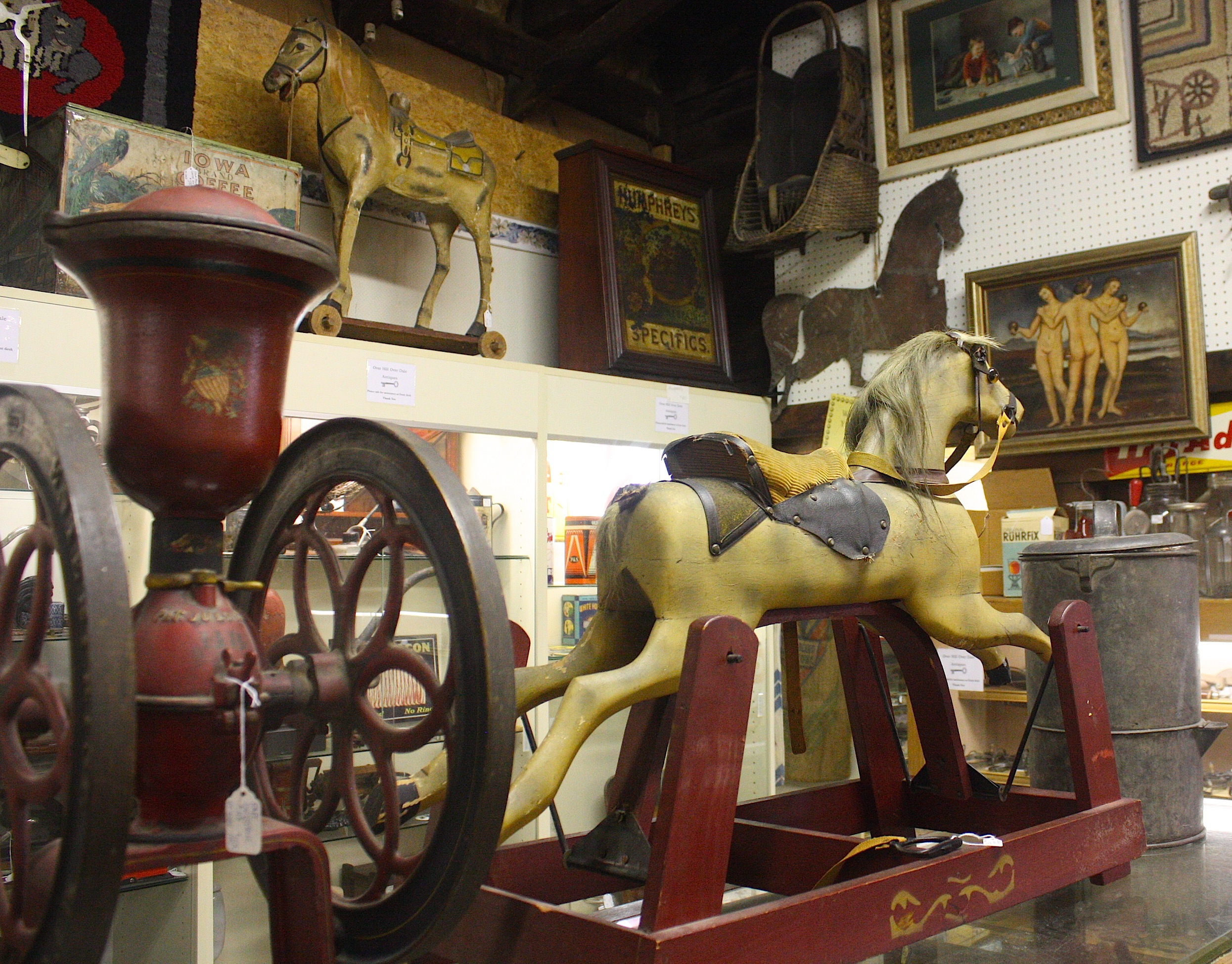
After hauling my purchase back to my car, I continued to the Village Blacksmith Antiques, a large, well-organized shop with a little bit of everything. And then I went across the street to the Granary Antique Mall (above). This shop may not look like much from the outside, but it’s actually THE place for high-end antiques in Walnut. It reminded me a bit of the big antiques mall in Red Wing, Minn. – a truly wonderful place. The Granary has 60 booths on two levels, with fabulous collections of furniture, pottery, antique toys, and so much more. This is the place for serious buyers.

Along the west side of the main street you’ll find Sugar Grove Antiques, Corn Country Antiques, Victorian Rose Antiques, Esther’s Antiques (above), and more. By this time I was getting antiques fatigue, but I did enjoy the mix of offerings, including primatives, glassware, jewelry, and vintage scarves.
I didn’t visit every store, so if you’re serious about your antiques, you should check out the website.
Walnut is located 85 miles west of Des Moines on I-80, an easy drive. The town has just 785 residents but reportedly attracts more than 80,000 tourists annually.
The annual Walnut Antique Show is the biggest draw, with more than 300 dealers lining the streets. The 33rd annual show will be held Friday through Sunday, June 19-21, 2015.
If you don’t want to wait until next summer, there’s also the Walnut Antique Fall Festival held Saturday, Sept. 13 (8 a.m.-6 p.m.) and Sunday, Sept. 14 (8 a.m.-3 p.m.) This show features Red Wing pottery, plus primatives, advertising, and collectibles.
Cedar Rapids: Another look
I’m chipping away at Cedar Rapids. I’ve visited the state’s second-largest city a dozen times or more, mostly for business, but often with a little time to kill. I’ve written about the Czech Village and National Czech & Slovak Museum. I’ve also blogged about the Grant Wood collection at the Cedar Rapids Museum of Art and the Grant Wood Studio.
Sometimes when I’m in Cedar Rapids for work, I end up going to Iowa City or Mt. Vernon to eat or shop. I’m definitely not a Cedar Rapids connoisseur. But I’m working on it.

When I was in town earlier this week, I explored the New Bohemia district near the Czech Village. I think it’s got awesome potential. I drank coffee at Brewhemia (1101 3rd St. SE), a fun, urban coffee shop / bar next door to an art exhibition space. For lunch, I tried to visit the NewBo City Market (1100 3rd St. SE), but it was closed. It’s definitely on my list for next time – just so long as I’m there Thursday through Sunday. The market features anchor merchants selling food that ranges from cupcakes to eggs to pizza, plus a variety of guest merchants – indoors and (when the weather permits) outdoors.
Disappointed that I couldn’t eat lunch at the market, I opted for the Parlor City Pub & Eatery (1125 3rd St. SE), where I ordered a veggie pizza and a side salad and found it quite pleasant if rather unexceptional.

After lunch, I visited the African American Museum of Iowa (55 12th Ave. SE). I didn’t really know what to expect from this museum – if it would feature history, culture, art, music, or something else. The museum opened in 2003 with a permanent exhibit, “Doorways: A History of African Americans in Iowa.” A few years later, the building was badly damaged in the flood of 2008 and re-opened in 2009 – so it has the feeling of a very new museum. Today’s permanent exhibit is “Endless Possibilities,” a history of African Americans before, during, and after the Civil War and through the Civil Rights Movement – with some relationships to Iowa but on a fairly national scope. Photographs, artifacts, newspapers, and multimedia tell the story.

One highlight is a life-size photograph of President Barack Obama, First Lady Michelle Obama, and their two daughters after winning the Iowa Caucus in 2008. There’s also a mention of Iowa State’s Jack Trice and George Washington Carver. The last part of the exhibit is devoted to African American musicians and musical styles.

It’s a quick visit and well worth the $5 entry fee. Although I have to laugh when I think about the older woman who greeted us when we walked in. She told us how much we owed but could not make change when we offered her cash. (“I’m a volunteer,” she explained.) And then, later, after we’d toured the museum, I asked her what year the museum opened and she couldn’t answer that most basic of questions. “There’s a seven-minute video you can watch,” she offered.
I’m not sure why she was there.
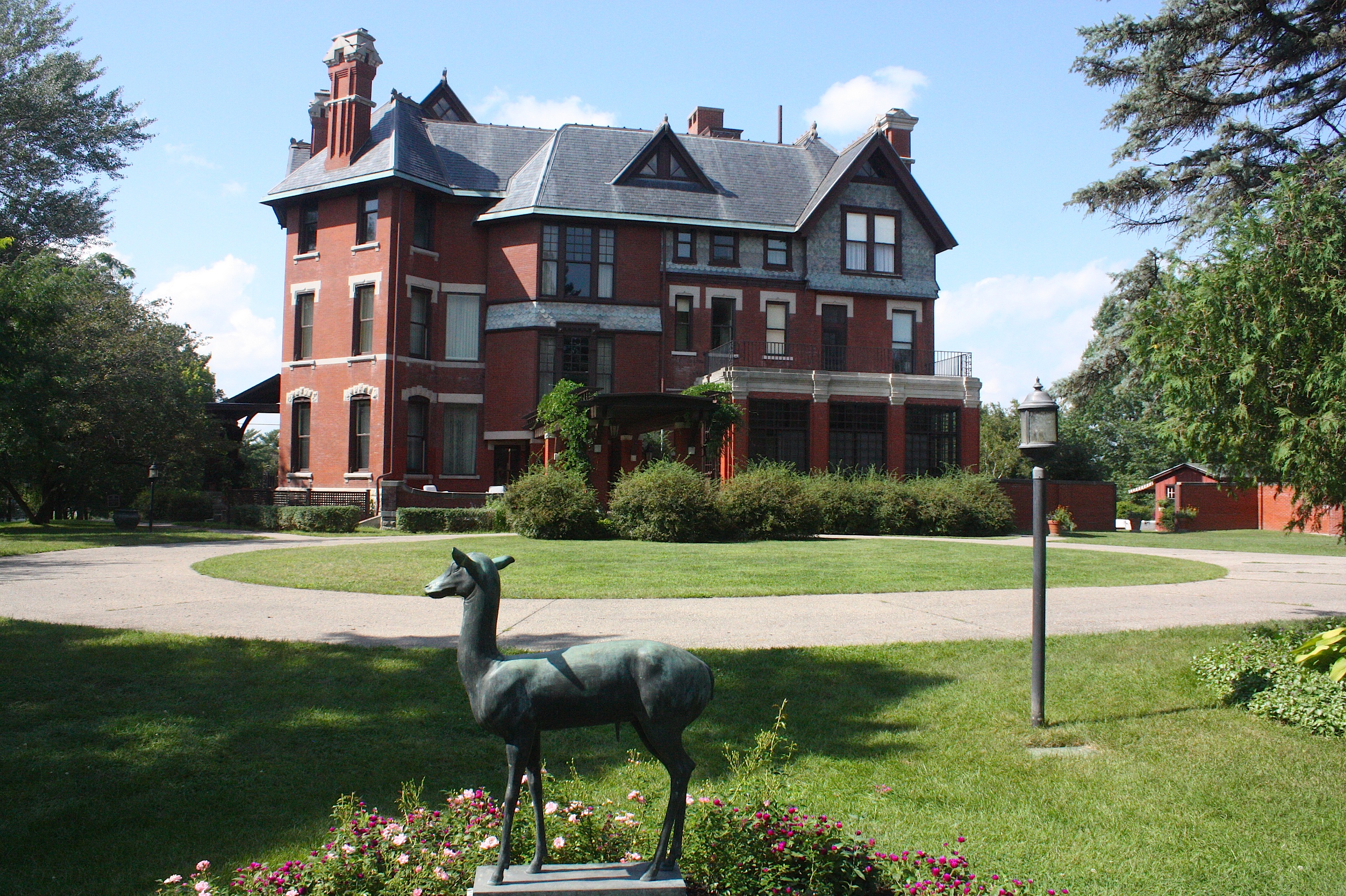
Our last stop was Brucemore national historic site and cultural center – which sounds sort of bland and boring, but believe me, it’s one hell of a cool place. I still can’t figure out how I didn’t know about it. I’d seen the brown signs on the highway but all I really knew about it was that it was a mansion.
So, yeah, it’s a mansion. But it’s got a fascinating history, and the architecture and grounds are spectacular. The place is 26 acres filled with not just the huge house and its porches and swimming pool but also a carriage house, servants’ quarters, greenhouses, orchard, garden house, tennis court, gardens galore, a pond, and a pet cemetery (I’ll get to that later). It just knocks your socks off.
I should mention that I was there on the ONE day of the week that the house isn’t open for tours: Monday. This was sort of unfortunate timing on my part, but I have to admit that sometimes I’d just rather nose around the yard and look at the house from the outside instead of taking a guided tour. Sometimes those are long and, frankly, boring. (If you decide you want to do it anyway, the cost is $7 and the house is open March through December.)
Luckily, the visitor center is open every day of the week, and it’s just chock full of photographs and films and information about the people who lived in Brucemore. Besides the awesome grounds, the history was my favorite part.
In a nutshell: A widow, Caroline Soutter Sinclair, built the mansion in the 1880s for her six children. She must have been richie-rich because the house is enormous – 21 rooms. Her husband ran Sinclair & Company meatpacking facility (he died in 1881 after falling into an open elevator shaft…bummer). In 1906, after Caroline’s children were grown, she moved into a smaller house in town and traded the home to George and Irene Douglas.
The Douglases were a Quaker Oats family and also owned a firm that produced cornstarch. The name Brucemore came from George’s middle name, Bruce, with an “allusion to the moors of Scotland.” The Douglas family tripled the property size and added landscaping and buildings. In 1937, 14 years after George’s death, Irene bequeathed the Brucemore estate to her eldest daughter, Margaret Douglas Hall.
And that’s when things get really interesting. Margaret and her husband, Howard, apparently had a gazillion dogs – all German shepherds and mostly named King – because they are buried in the pet cemetery and enshrined in dog statues throughout the grounds. You can view photos and films of the dogs in the visitor center. But more entertaining than the dogs by far are the lions: three of them, all named Leo. The first, purchased in 1936, was a descendant of Jackie, the MGM lion. How amazing is this? He did not live long, but the second Leo lived for 13 years and is featured in home movies, wrestling and rolling around with the dogs and with Howard. Leo the 2nd is buried in the pet cemetery. I don’t know too much about Leo the third.
The film library is remarkable. From the late 1920s through the 1960s, the Halls documented scene of vacations, family and friends – and also behind-the-scenes images from the set of “Gone With the Wind.” I’m not sure how he managed it, but you could just sit and watch this stuff all day.
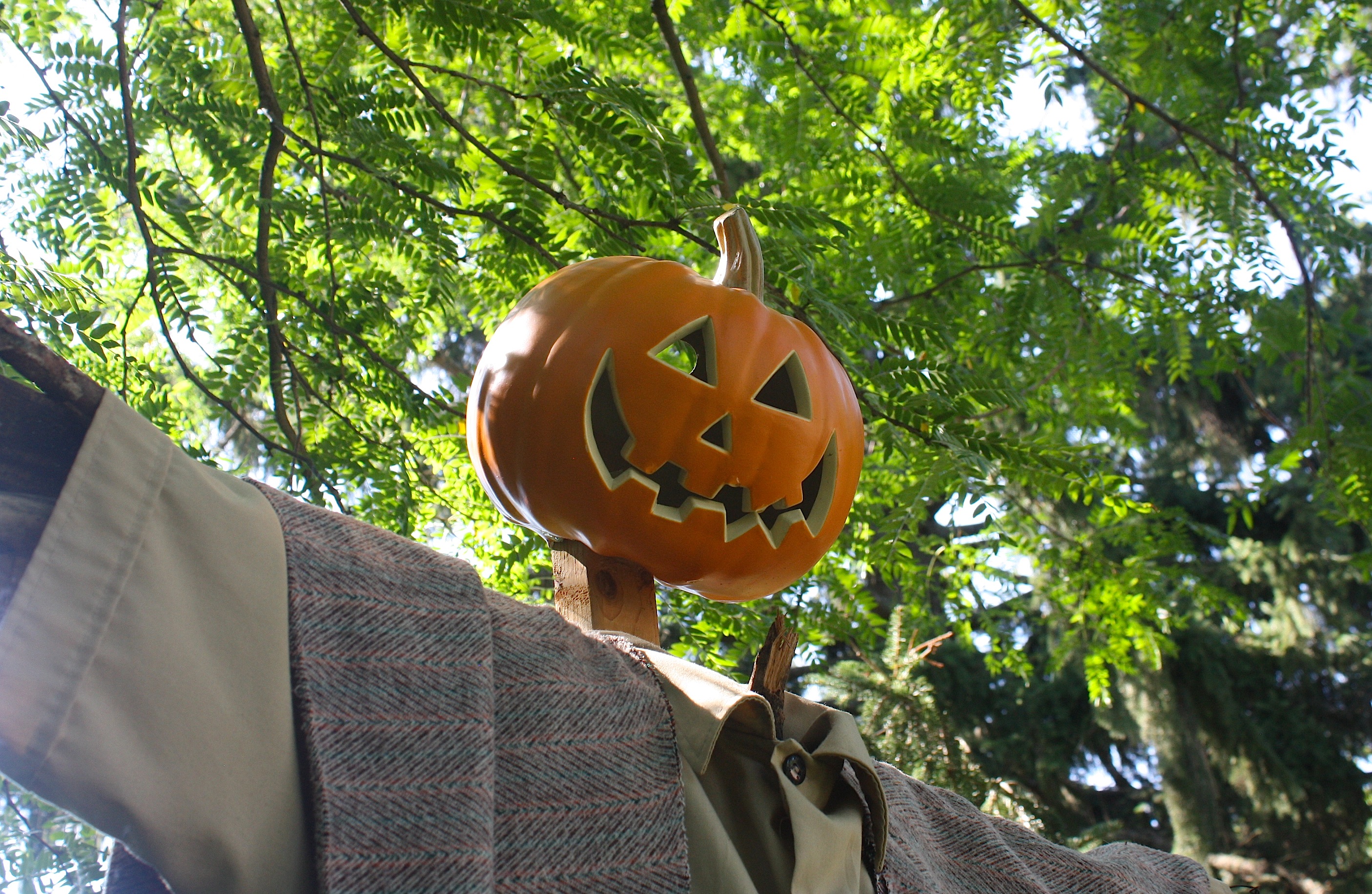
I probably haven’t done this amazing place justice – you really must visit it yourself (at 2160 Linden Dr. SE). They have lots of events – art shows, theatre performances, concerts, festivals, and special exhibits. There’s a scarecrow invasion in October you might want to check out.


 Iowa Girl on the Go